
Archive

February 4, 2026

Browsing

As the House crushed Republican resistance to a Trump-backed funding package to end the latest partial government shutdown, lawmakers in the upper chamber weren’t confident that Congress could avoid being in the same position in the coming weeks.

President Donald Trump and Senate Minority Leader Chuck Schumer, D-N.Y., brokered the deal to end the shutdown last week. That funding truce included a move to sideline the controversial Department of Homeland Security (DHS) funding bill in favor of a short-term extension to keep the agency open.

The House’s passage of the package, which funds 11 out of 12 government agencies under Congress’ purview, sets the stage for tense negotiations between the White House and Senate Democrats over reforms to DHS.

But several Senate Republicans are questioning whether two weeks, which had shrunk to just nine days as of Wednesday, would be enough time to avert another partial shutdown — this time only for DHS.

‘I think it’s gonna be very difficult to get the funding bill done for DHS in two weeks,’ Sen. Rick Scott, R-Fla., told Fox News Digital.

Scott was one of a handful of Republicans in the upper chamber that rejected the compromise plan and the underlying original package because of bloated spending on earmarks and concerns that Senate Democrats would effectively try to kneecap Immigration and Customs Enforcement (ICE) operations across the country.

‘We’re going to be in a worse spot,’ Scott said. ‘I mean… all their earmarks got done, and then now they’re going to want to, you know, they want to [get] busy de-fanging and defunding ICE.’

Congressional Democrats wanted to relitigate the bipartisan DHS bill after the fatal shooting of Alex Pretti during an immigration enforcement operation in Minneapolis. The demand forced Trump to intervene and thrust the government into a partial shutdown on Friday.

While the funding deal made it across his desk, it won’t get Congress out of the jam it’s in, given the short amount of time lawmakers have to negotiate the bill, which is consistently the most difficult spending bill to pass year in and year out. 

Senate Majority Leader John Thune, R-S.D., noted that once negotiations began, Congress had a ‘very short timeframe in which to do this, which I am against.’

‘But the Democrats insisted on, you know, a two-week window, which, again, I don’t understand the rationale for that,’ Thune said. ‘Anybody who knows this place knows that’s an impossibility.’

Some Senate Democrats did not want to weigh in on a hypothetical scenario just days away, but Sen. Mark Kelly, D-Ariz., contended that because of the events in Minnesota, ‘there should be some motivation across the aisle to do something on, you know, all these issues.’ 

‘I mean, I think [DHS Secretary] Kristi Noem should be fired, leadership needs to be changed at ICE, their budget needs to be the right size,’ Kelly said. ‘We got to get them looking like normal police officers.’

Senate Appropriations Chair Susan Collins, R-Maine, struck a more positive tone. 

She told Fox News Digital that Congress would be in a much better position, considering that lawmakers will have passed 11 out of the 12 bills needed to fund the federal government. 

‘We’ll now start the negotiations on DHS, and I hope we’ll be successful, but I don’t see how you can compare where we are today,’ Collins said.

Thune believed that Noem’s announcement that ICE agents in Minneapolis would begin wearing body-worn cameras could act as a sweetener for Democrats. There is already $20 million baked into the current bipartisan DHS funding bill for body cameras. 

Schumer rejected that olive branch from Noem, arguing that it didn’t come nearly close enough to the portfolio of reforms Democrats wanted for the agency. And he reaffirmed that Senate Democrats wanted actual legislative action on DHS reforms, not an executive order. 

‘We know how whimsical Donald Trump is,’ Schumer said. ‘He’ll say one thing one day and retract it the next. Same with Secretary Noem.’

‘So, we don’t trust some executive order, some pronouncement from some Cabinet secretary. We need it enshrined into law.’

When asked if lawmakers would need to turn to another short-term funding patch, Schumer argued that ‘if Leader Thune negotiates in good faith, we can get it done. We expect to present to the Republicans a very serious, detailed proposal very shortly.’

But Thune has said for several days that it would be the White House in the driver’s seat, and ultimately it would be Trump who could broker a new deal. 

‘But at some points, obviously it has to be the White House engaged in the conversation with the Senate Democrats, and that’s how that thing’s gonna land,’ Thune said.

This post appeared first on FOX NEWS

House Republicans who are spearheading the charge of another ‘big, beautiful bill’ say they only have a short window of time to pass a massive piece of legislation aimed at lowering costs for Americans across the board.

‘We need to see good movement within the month of February that puts us on a path to achieve this by late spring, early summer,’ Republican Study Committee (RSC) Chairman August Pfluger, R-Texas, told Fox News Digital.

President Donald Trump led Republicans through passing the One Big, Beautiful Bill Act last year, sprawling legislation that made good on versions of several Trump campaign promises like reducing taxes on tipped and overtime wages, extending his 2017 tax cuts, and surging more money toward his immigration crackdown.

The budget reconciliation process makes such a feat possible by lowering the Senate’s threshold for passage to line up with the House’s own simple majority line, empowering the party holding the levers of power in Congress to pass sweeping fiscal changes to U.S. law.

A large contingent of Republican lawmakers, including Speaker Mike Johnson, R-La., have said they want to use that process again sometime this year. Pfluger’s RSC, the largest caucus in the House GOP, released a framework last month with recommendations on a bill that would lower costs in areas like housing, healthcare and energy.

Pfluger told Fox News Digital that affordability would likely be a ‘major driver’ of another such GOP bill, but said he was still working on getting input from other areas of the House Republican Conference.

‘I’m sure that there will be refinement as we hear feedback from the different groups. But we do believe that it’s a solid framework. We believe that it’s a winning issue based on good policy,’ Pfluger said.

But both he and House Budget Committee Chairman Jodey Arrington, R-Texas, have acknowledged they will need to work fast — particularly with the 2026 midterm elections coming in November.

‘I would be embarrassed as a leader and as a conservative if our conference and Republicans in Washington won’t rally in these 10 or 11 months we have before November, where we still have this window of opportunity to strike,’ Arrington said in a forthcoming episode of the RSC’s ‘Right to the Point’ podcast, which Fox News Digital got an exclusive first look at.

He said elsewhere in the podcast that Republicans ‘probably have a three-month window’ to take meaningful action, lining up with Pfluger’s own prediction that action should happen by springtime.

Pfluger said he hoped to get the first key step done this month after sending instructions on what kind of cuts to enact to various House committees.

But Republicans are currently dealing with a one-seat majority in the House until a special election to replace former Rep. Marjorie Taylor Greene, R-Ga., takes place in March.

That could get reduced back down in April after a special election for a blue-leaning seat to replace New Jersey’s new Gov. Mikie Sherrill. Republicans won’t get more breathing room until early August, when California holds a special election for the GOP-leaning seat that was held by the late Rep. Doug LaMalfa, R-Calif.

Their first reconciliation bill notably passed with all but two House Republicans on board.

‘We have a path. We’ve dug that path, and we should just do it for the things that we can all agree on,’ Arrington argued.

He said a second bill ‘doesn’t have to be as big and comprehensive, it needs to be targeted on the things that were either left undone, things that fell out, that we should put back in… like not allowing tax dollars to go to transgender procedures and not allowing the fungible federal dollars to support states that use their state Medicaid dollars to fund illegals.’

But it’s not yet clear that such policies could make it in or gain the support of moderate Republicans who are wary of an election cycle that’s expected to be an uphill climb for the GOP.

Pfluger, however, told Fox News Digital that he hoped they could even get some Democratic support if the bill stayed focused on affordability measures.

‘I believe that we are going to produce something that is going to make it very difficult for Democrats to vote against,’ he said. ‘I would hope that we would have something on the board that would get Democrat support in some cases.’

This post appeared first on FOX NEWS

House conservatives are quietly grumbling about the deal President Donald Trump entered into with Senate Democrats to keep the government open and running — particularly regarding the Department of Homeland Security (DHS).

Some Republican lawmakers are concerned that the plan will leave them forced to swallow concessions on immigration enforcement policies that they would not normally entertain while the GOP holds all the levers of power in Washington, albeit with slim majorities.

‘I don’t think we have any more leverage,’ one House Republican granted anonymity to speak candidly told Fox News Digital. ‘We just shot ourselves in the foot, and nine days later we’ll do it again.’

The compromise between Democrats and the White House funds 97% of the federal government through Sept. 30, but only keeps DHS running until Feb. 13.

That’s because House and Senate Democrats walked away from an initial compromise that would similarly fund DHS through the end of fiscal year (FY) 2026, in exchange for added guardrails on Immigration and Customs Enforcement (ICE) like a new body-worn camera mandate and required training on de-escalation and public engagement.

The earlier plan passed the House, mostly with only GOP support, but was rejected by Senate Democrats in the wake of unrest in Minneapolis over Trump’s immigration crackdown. Federal agents shot and killed two U.S. citizens there during anti-ICE demonstrations, with tensions escalating thanks to those fatal encounters and angry rhetoric by progressive local officials.

Trump’s new deal for DHS with Senate Minority Leader Chuck Schumer, D-N.Y., is aimed at giving time for more bipartisan negotiations on a longer-term funding plan.

But the move frustrated some House Republicans all the way up to Speaker Mike Johnson, R-La., who told his conference on a lawmaker-only call Friday that he was ‘frustrated’ by the compromise but that congressional Republicans needed to stick by Trump’s decisions as the leader of their party.

He also told reporters during a Tuesday morning press conference, ‘This is not my preferred route. I wanted to keep all six bills together.’

‘But listen, the president agreed with Schumer that they would separate Homeland, and we’ll do that, and we’ll handle it,’ Johnson continued. ‘The Republicans are going to do the responsible thing.’

Frustrations about Trump negotiating away their leverage were brought up again by House conservatives during a GOP lawmaker-only meeting on Tuesday morning, two sources told Fox News Digital.

One senior House Republican said they’d heard such complaints but commended Trump for acting responsibly in a difficult situation.

‘I think there were no good options. We obviously don’t want a shutdown, Democrats are very capable of that, they’ve demonstrated they’re willing to do that,’ the senior House Republican said.

‘They backed out on their end of the deal, and politically, they made a calculus, so the president had to be the bigger person. So, yeah, of course there was leverage that was given away. But leaders are the ones who can de-escalate. He seems to be de-escalating.’

Others who spoke on the record said they trusted Trump but were pessimistic about getting to Feb. 13 with a plan that Republicans could all support.

‘Homeland Security is doing a tremendous job. It’s unfortunate that two people got shot, but it’s unfortunate that 20 million illegals came to America, too,’ Rep. Ralph Norman, R-S.C., said Monday.

‘Trump, I trust his judgment. I’m just saying my gut instinct is…they’ll use the two weeks to demagogue [DHS Secretary] Kristi Noem, they’ll use the two weeks to say how bad everything is with ICE. I think they’ll take the two weeks to make unreasonable demands on dismantling ICE. That’s not going to happen.’

Rep. Mark Harris, R-N.C., told Fox News Digital, ‘I am concerned, but I’m hopeful that the president in the negotiations will hold firm, and hold strong.’

But two more House Republicans who spoke with Fox News Digital privately signaled they did not see a path to GOP success on DHS after Trump’s talks with Senate Democrats.

‘Whatever will come of that will be something that I probably won’t be able to support,’ one of them said.

‘How are we in a better negotiating position in two weeks? The only difference will be time,’ the second GOP lawmaker said. ‘At the end of the day, I’m worried that we’re going to make a lot of concessions that we wouldn’t normally make.’

White House spokeswoman Abigail Jackson told Fox News Digital that Trump would hold firm on implementing his immigration law.

‘President Trump and his entire Administration have been clear: we will not waver when implementing the President’s electoral mandate to enforce federal immigration law. Democrats should not hold funding hostage for disaster relief as many Americans continue to recover from winter storms,’ Jackson said.

This post appeared first on FOX NEWS

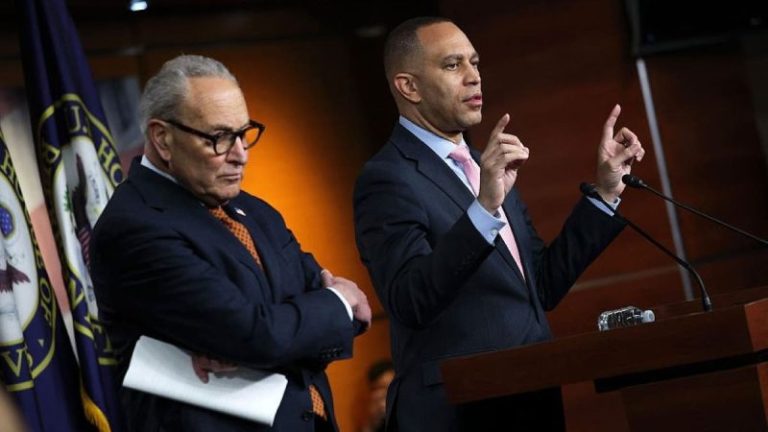
Senate Majority Leader John Thune, R-S.D., doesn’t have confidence that top congressional Democrats want to fix Homeland Security funding as Congress gears up for tense negotiations in the coming days. 

With the partial four-day government shutdown now over, Democrats and Republicans are readying to relitigate the controversial Department of Homeland Security (DHS) bill, which threatened to completely derail a previous bipartisan funding deal. 

And with nine days on the clock to figure out a way forward, Thune doesn’t believe that House Minority Leader Hakeem Jeffries, D-N.Y., or Senate Minority Leader Chuck Schumer, D-N.Y., are prepared to actually reach a bipartisan deal on the bill. 

When asked if he viewed Jeffries, who rebelled against Schumer’s funding deal with President Donald Trump, as a good-faith partner in the coming back-and-forth, Thune said, ‘He’s just not.’

‘He and, for that matter, Leader Schumer, both are afraid of their shadows, and they’re getting a lot of rollback and pressure from their left,’ Thune said. ‘So, I don’t think they want to — particularly in [Jeffries’] case, I don’t think he wants to make a deal at all.’

Schumer on Tuesday said that Democrats would have a proposal ready for Republicans to review that same day, but Thune noted that no such list had been handed over to his side of the aisle. 

There may still be lingering discourse between the top Democratic leaders, too, after Jeffries turned his back on the Trump-Schumer funding deal. However, both met on Tuesday night, and Schumer affirmed that they were on the same page.

Meanwhile, DHS is currently operating under a two-week continuing resolution (CR) that maintains previous funding levels until Congress can pass legislation to fully fund it. But Thune and other Republicans believe that the truncated time period just isn’t long enough to actually hash out a deal. 

And it’s an open question whether Congress will again need to temporarily extend the funding patch, or allow the agency to shut down.

Compounding frustrations among Republicans is that the original DHS bill was the product of bipartisan negotiations and included several guardrails and reporting requirements targeting Immigration and Customs Enforcement (ICE) that would limit or block funding if they weren’t met. 

‘I think they want to litigate, have the issue as a political issue,’ Thune said. ‘Whether or not there’s a solution remains to be seen, but at least what they’re saying publicly suggests that that’s not their objective.’ 

This post appeared first on FOX NEWS

President Donald Trump said he spoke to Chinese President Xi Jinping Wednesday to discuss a range of issues, including the war between Ukraine and Russia, while stressing that their relationship ‘is an extremely good one’ that will bring ‘many positive results’ in the coming years.

The president and Xi also discussed Trump’s upcoming trip to Beijing in April, which he said he ‘very much’ looks forward to.

‘I have just completed an excellent telephone conversation with President Xi, of China. It was a long and thorough call, where many important subjects were discussed, including Trade, Military, the April trip that I will be making to China (which I very much look forward to!), Taiwan, the War between Russia/Ukraine, the current situation with Iran, the purchase of Oil and Gas by China from the United States, the consideration by China of the purchase of additional Agricultural products including lifting the Soybean count to 20 Million Tons for the current season (They have committed to 25 Million Tons for next season!), Airplane engine deliveries, and numerous other subjects, all very positive!’ Trump posted to his Truth Social.

‘The relationship with China, and my personal relationship with President Xi, is an extremely good one, and we both realize how important it is to keep it that way,’ he continued. ‘I believe that there will be many positive results achieved over the next three years of my Presidency having to do with President Xi, and the People’s Republic of China.’

The president’s call with Xi comes on the same day the Chinese president announced that he had a separate conversation Wednesday with Russian President Vladimir Putin. 

This is a developing story. Please check back for updates. 

This post appeared first on FOX NEWS

(TheNewswire)

The Company is also granting, subject to TSXV approval, 2,170,000 incentive stock options to directors, officers and consultants of the Company.  These Options will be valid for three years and will vest immediately.  All Options granted herein shall have an exercise price of $0.20.

About Pinnacle Silver and Gold Corp.

Pinnacle is focused on the development of precious metals projects in the Americas.  The high-grade Potrero gold-silver project in Mexico’s Sierra Madre Belt hosts an underexplored low-sulphidation epithermal vein system and provides the potential for near-term production. In the prolific Red Lake District of northwestern Ontario, the Company owns a 100% interest in the past-producing, high-grade Argosy Gold Mine and the adjacent North Birch Project with an eight-kilometre-long target horizon.  With a seasoned, highly successful management team and quality projects, Pinnacle Silver and Gold is committed to building long-term, sustainable value for shareholders.

Signed: ‘Robert A. Archer’

President & CEO

For further information contact:

Email:        info@pinnaclesilverandgold.com

Tel.:  +1 (877) 271-5886 ext. 110

Website: www.pinnaclesilverandgold.com


Neither the TSX Venture Exchange nor the Investment Industry Regulatory Organization of Canada accepts responsibility for the adequacy or accuracy of this release.


Copyright (c) 2026 TheNewswire – All rights reserved.

News Provided by TheNewsWire via QuoteMedia

This post appeared first on investingnews.com

(TheNewswire)


TSX-V: PHD
OTC-PINKS: PRRVF
FRANKFURT EXCHANGE: 7RH1-F

VANCOUVER TheNewswire – February 4, 2026, Providence Gold Mines Inc. (‘Providence’ or the ‘Company’) announces that further to the news release of January 16, 2026 that the Company is increasing the announced Private Placement of up to $150,000, to up to $180,000. Each Unit consists of one common share and one full non-transferable warrant repriced to $0.065 from $0.05. The warrants are exercisable for a period of two years from the date of issue.  Finder’s fees may be paid at 7% cash and 7% finder’s warrants exercisable at $0.065 for a period of one year from the date of issue.


The proceeds from the Private Placement will be used for administration and continued sampling of the underground and surface workings to evaluate the potential of the available mineralization in advance of the planned 1000-ton bulk sample at the La Dama De Oro gold and silver property.


Remedial Road work on the main access road has been completed during the past several weeks. Once sampling confirms the robust potential mineralized zone the Company then plans to commence the 1000-ton bulk sample by April 2026.


The Property:


The La Dama de Oro gold property is a historical high grade gold producer and has permits for Water, Road, Environmental, Plan of Operations, Mill Site, and is approved for a bulk sample The Property has had no drilling or any modern-day scientific exploration and consequently has no developed or identified NI 43 101 compliant resources.


The La Dama de Oro Property is in the Silver Mountain Mining District, within the structurally complex Eastern California Shear Zone and the intersection with the San Andreas Fault Zone. Bedrock geology includes Mesozoic quartz monzonite that intrudes the Jurassic Sidewinder Volcanics. The structural geology of the region implies a sequence of compressional and extensional events that reactivated favorably oriented zones of weakness for the circulation of hydrothermal fluids. The main zone of mineralization is hosted by the La Dama de Oro Fault, a shallow northeast-dipping oblique-slip fault.


The mineralization at the property is classified as a structurally controlled, low-sulfidation epithermal gold-silver vein system. Gold and silver mineralization is associated with multi-phase quartz veining, brecciation, and pervasive hydrothermal alteration along the La Dama de Oro Fault. The largest known vein is 4.5 feet at its widest point and remains open to exploration for over 6,000 feet. The gold system has potential not just within the La Dama de Oro vein and other known veins but as well for additional discovery of other yet to be discovered veins.

The scientific and technical information contained in this news release has been reviewed and approved by Zachary Black, SME-RM, a Qualified Person as defined under NI 43-101. Mr. Black is a consultant and is independent of Providence Gold Mines Inc.


For more information, please contact Ronald Coombes, President, and CEO of the Company.


Ronald A. Coombes, President & CEO

Phone: 604 724 2369

roombes@providencegold.com


CAUTIONARY STATEMENT REGARDING FORWARD-LOOKING INFORMATION


Neither the OTCQB and or the TSX Venture Exchange nor its Regulation Services Provider (as that term is defined in the policies of the TSX Venture Exchange) accepts responsibility for the adequacy or accuracy of this release.


ll statements, trend analysis and other information contained in this press release relative to markets about anticipated future events or results constitute forward-looking statements. All statements, other than statements of historical fact, included herein, including, without limitation, statements relating to the permitting process, future production of Providence Gold Mines, budget and timing estimates, the Company’s working capital and financing opportunities and statements regarding the exploration and mineralization potential of the Company’s properties, are forward-looking statements. Forward-looking statements are subject to business and economic risks and uncertainties and other factors that could cause actual results of operations to differ materially from those contained in the forward- looking statements. Important factors that could cause actual results to differ materially from Providence Gold Mines expectations include fluctuations in commodity prices and currency exchange rates; uncertainties relating to interpretation of drill results and the geology, continuity and grade of mineral deposits; the need for cooperation of government agencies and native groups in the exploration and development of properties and the issuance of required permits; the need to obtain additional financing to develop properties and uncertainty as to the availability and terms of future financing; the possibility of delay in exploration or development programs and uncertainty of meeting anticipated program milestones; and uncertainty as to timely availability of permits and other governmental approvals. Forward-looking statements are based on estimates and opinions of management at the date the statements are made. Providence Gold Mines does not undertake any obligation to update forward-looking statements except as required by applicable securities laws. Investors should not place undue reliance on forward-looking statement

Copyright (c) 2026 TheNewswire – All rights reserved.

News Provided by TheNewsWire via QuoteMedia

This post appeared first on investingnews.com

While the first phase of the AI gold rush was defined by massive investments in centralized data centers, 2026 is about proving those billions can translate into fast, reliable AI that people will use every day.

One Canadian startup, PolarGrid, is betting that the answer lies at the edge rather than in ever‑bigger centralized campuses. Led by former TekSavvy president Rade Kovacevic, the company has built a prototype network that shifts AI inference closer to end users to cut response times.

As artificial intelligence models become increasingly complex and applications demand real-time responsiveness, the physical infrastructure that minimizes delays will become a decisive competitive advantage.

This speed could be a key area for market growth and differentiation in the coming years.

The shift from building to proving value

Analysts expect hyperscalers to spend US$300 billion to US$600 billion on AI infrastructure in 2026. But as Purpose Investments’ Nicholas Mersch notes, the focus is turning “from who can build fastest to who can drive the highest revenue and margin per dollar of AI infrastructure.”

Power limits, with some data centers pushing past 1 gigawatt, and supply shortages for key components like high‑bandwidth memory, are biting. Centralized architectures also force user requests to travel long distances to distant servers, adding three to 10 times more lag than traditional web traffic.

That design breaks the experience for voice assistants or video agents, where even a one‑second pause feels wrong.

As models and chips have improved, on‑chip inference times for leading voice agents have dropped into the hundreds‑of‑milliseconds range, close to human reaction time, shifting the main source of delay to the network path between user and data center.

As PolarGrid CEO Rade Kovacevic puts it, “inference latency is the bottleneck for real-time AI at scale—whether it’s real-time voice or video solutions.”

The company is an edge‑focused player trying to attack that bottleneck; its prototype cuts network latency by more than 70 percent versus centralized hyperscalers and brings total response times toward 300 milliseconds, making it feel more like a human reply.

Why latency matters

Kovacevic compares today’s AI moment to the early commercial internet, when waiting 30 seconds for an image to load or 12 minutes to download a song on dial‑up still felt magical compared to mailing photos or driving to the mall for a CD.

As people got used to that technology, their tolerance for delay collapsed to near‑instant loads, and he expects the same pattern to play out with AI.

“Initially we’ve all been enamored with the new features and capabilities,” he explained, “but as we’ve gotten used to it, our expectations have continued to increase.”

For voice agents, that means anything more than a brief, human‑like pause starts to feel jarring and breaks trust.

In practice, that gap shows up in everyday workflows. Kovacevic points to talent‑recruitment platforms that rely on voice agents for first‑round interviews: if latency causes the bot and the candidate to talk over each other, top applicants drop off, and the whole funnel underperforms.

The same thing happens in customer service, where consumers might accept an AI agent to avoid an hour on hold, but not if responses feel slow, misheard or robotic.

Edge is the ‘neighborhood vending machine’

Sending data to a central cloud in, for example, Virginia or California and back to Canada creates a speed ceiling for real-time applications like autonomous driving, remote surgery and instant financial fraud detection.

The core idea behind edge AI is simple: instead of sending every request to a handful of giant campuses, inference runs on regional or local nodes closer to where users actually are.

Latency comparison visuals

Image via PolarGrid

Kovacevic describes it as swapping a warehouse in another state for a neighborhood vending machine, shortening the trip so results arrive fast enough to feel instant. That approach doesn’t remove the need for large, centralized training clusters, but it does change where the latency‑sensitive part of the workload runs.

For policymakers, that architectural shift intersects with a parallel push for sovereign AI. Canada’s federal government has signaled plans for large, domestically owned data solutions, while global enterprises explore regional and bare‑metal platforms to gain more control over security‑sensitive workloads. Edge networks that can keep data local while reducing latency stand to benefit from both trends.

Startups like PolarGrid are positioning themselves as the networking “plumbing” for that world: infrastructure that other AI builders plug into so their voice, video and agentic applications behave in real time without rebuilding their own global networks.

PolarGrid’s prototype: a real-world test

That gain doesn’t come from hardware so much as where it is placed: PolarGrid distributes GPUs across major population centers in North America, so requests travel shorter physical distances before being processed.

Strategically, this approach fits the broader verticalization trend in AI infrastructure, where the winners are expected to control more of the stack and squeeze more utility out of each dollar of capex.

Instead of pouring money into new data centers, PolarGrid is trying to wring better user experience and utilization from existing capacity, potentially easing power constraints and overbuild risk. Its early pilots are focused on latency‑sensitive verticals like voice agents and interactive entertainment, where any improvement in responsiveness can translate directly into higher engagement and revenue.

What investors should watch

In a year of capex digestion, plays like this could deliver the ROI hyperscalers chase: higher revenue from usable AI without endless spending.

As Mersch put it, success goes to those capturing “revenue per dollar of infrastructure.” PolarGrid shows edge might be that path, turning AI from novelty to an everyday tool. Investors eyeing efficient bets may want to take note.

Securities Disclosure: I, Meagen Seatter, hold no direct investment interest in any company mentioned in this article.

This post appeared first on investingnews.com

Australia is taking part in a ministerial meeting aimed at exploring a strategic critical minerals alliance alongside the US, Europe, the UK, Japan and New Zealand.

According to media reports, the talks were convened by US Secretary of State Marco Rubio and are scheduled for February 4. The gathering marks the second such summit in less than a month and is expected to bring together ministers from around 20 countries, including G7 members the US, UK, Japan, France, Germany, Italy and Canada.

Discussions are set to focus on strengthening supply chain resilience, supporting clean energy transitions and deepening cooperation on strategic critical minerals. Early agenda items reportedly include potential US-backed price support mechanisms for critical minerals and rare earth elements.

However, reports indicate that the Trump administration has since moved away from pursuing a minimum price guarantee framework.

“The shift, which comes as a US Senate committee reviews a price floor extended to MP Materials (NYSE:MP) last year, marks a reversal from commitments made to industry and could set Washington apart from G7 partners discussing some form of joint price support or related measures to bolster production of critical minerals used in electric vehicles, semiconductors, defense systems and consumer electronics,” Reuters wrote in an exclusive.

Shares in Australia reportedly went down following the shift in plans, as Australia has been working towards becoming a key player in reducing critical minerals reliance on China.

Resources Minister Madeleine King was quoted by The Guardian as saying that the US decision to deflect from setting minimum pricing plans “won’t stop Australia” from pursuing its critical minerals reserve program.

In January, Australia announced that it intends to make its Critical Minerals Strategic Reserve (CMSR) operational by the end of 2026.

King detailed in a joint press release with Treasurer Jim Chalmers and Minister for Trade and Tourism Don Farrell that antimony, gallium and rare earths will be the first minerals of focus for the CMSR.

On Tuesday (February 3), the US was reported to be building a domestic stockpile of critical minerals, marking the Trump administration’s latest effort to reduce the country’s reliance on China for key materials and components used in cellphones, military equipment and renewable energy technologies.

This move also ties to the US and Australia deal signed last October, which outlined that both countries will each make more than US$1 billion in investments over the next six months for initial projects.

“Within a year, we’ll have critical minerals and rare earths that you won’t know what to do with them,” Trump said at the time.

More bilateral agreements on the supply chain are expected to be signed during the meeting.

Securities Disclosure: I, Gabrielle de la Cruz, hold no direct investment interest in any company mentioned in this article.

This post appeared first on investingnews.com

SpaceX on Monday acquired xAI, the artificial intelligence startup that also owns the X social media platform, in a deal combining two companies owned by Elon Musk.

Musk in a news release said that the combination would aim to pursue AI data centers in outer space.

The deal comes on the verge of SpaceX’s highly anticipated initial public offering, which is expected to occur later this year.

The deal creates ‘the most ambitious, vertically-integrated innovation engine on (and off) Earth, with AI, rockets, space-based internet, direct-to-mobile device communications and the world’s foremost real-time information and free speech platform,’ Musk said in a statement.

The combined company will become the world’s most valuable private company, worth more than $1.2 trillion, Bloomberg News reported. NBC News has not been able to verify the valuation, and the companies did not respond to requests for comment.

Musk went on to say that space would be a crucial avenue for building advanced artificial intelligence.

‘In the long term, space-based AI is obviously the only way to scale,’ Musk wrote. ‘The only logical solution therefore is to transport these resource-intensive efforts to a location with vast power and space.’

Musk also offered an ambitious timeline for starting to develop AI from space. He’s failed to meet many of the previous goals he set for his companies.

“My estimate is that within 2 to 3 years, the lowest cost way to generate AI compute will be in space,” he wrote in Monday’s news release.

SpaceX already conducts rocket tests using reusable parts, provides cellular phone and data services to T-Mobile customers, and is working with NASA to return humans to the moon in the near future.

Meanwhile, xAI, Musk’s bid to get in on the AI boom, has reportedly soared to a more than $200 billion valuation. Along the way, the company and its AI bot, Grok, have drawn criticism. Recently, the company limited its image generation technology after users said it was creating sexualized deepfakes. A number of state attorneys general and the European Union are investigating the company.

Musk’s companies have often been intertwined, but Monday’s deal brings them even closer together. Another one of Musk’s companies, Tesla, has invested in xAI and uses some of its technology.

Musk merged his social media site X with xAI in early 2025, but the tie-up between xAI and SpaceX marks the largest combination to date of Musk’s vast business projects.

Founded in 2002, SpaceX has helped catapult Musk to the ranking of richest person in the world, with a net worth of more than $670 billion. The company has quickly become a critical supplier of satellite-based internet around the world, with more than 9,000 satellites orbiting Earth, used by both consumers and governments. SpaceX also holds multiple NASA contracts.

This post appeared first on NBC NEWS