Archive

February 27, 2026

Browsing

President Donald Trump has lost his tariff case in the Supreme Court. However, with careful and prudent use of the tariff powers he does have, he can turn this into a win for his policies and for America.

The Supreme Court has just ruled in Learning Services v. Trump that the International Emergency Economic Powers Act (IEEPA) does not authorize the president to impose tariffs. While the act unquestionably gives him the power to regulate imports in the event of unusual and extraordinary emergencies, the dispute was whether tariffs – a kind of tax – are legally and constitutionally ‘regulation.’

While there were reasonable arguments on both sides, six of the nine justices ruled they are not, and that the IEEPA does not empower the president to impose tariffs. What are the likely economic consequences of this ruling, and what should it imply for future Trump trade policy?

First, note that as economic policy, tariffs are a bad idea. International trade raises incomes and promotes economic growth in every country that trades. Trade is mutually beneficial, win-win for all trading parties. It is a popular myth that trade destroyed American manufacturing. American manufacturing has steadily increased since 1970, more than doubling, as shown by data collected by the Federal Reserve Bank of St. Louis.

On the other hand, roughly 90% of the costs of the ‘liberation day’ tariffs have been borne by American businesses and consumers, as shown in analysis by economists at the New York Federal Reserve. The American economy has had solid growth and low unemployment under Trump, but this is owing to his excellent energy and deregulation policies, which have reduced regulatory burdens. Tariff costs are another burden on the economy. Removing this drag should further encourage economic growth and employment.

It is also a popular myth that a trade deficit is a loss for a country. The trade deficit, or current account, is balanced the capital and financial accounts, that is, foreigners investing in America. There are two reasons why foreign investment flows into America. One is that America’s security and dynamism make it an attractive place to invest, a good thing. The other is the Federal government’s growing appetite for borrowing to cover its burgeoning deficits, a bad thing. Tariffs and trade restrictions make America’s economy less dynamic and do nothing to curb the government’s fiscal irresponsibility. There is no good economic argument for tariffs.

However, for foreign policy and national security purposes, tariffs can have an important role. Numerous other laws authorize the president to impose such tariffs. For example, the Trade Act of 1974, Section 122 (under which Trump has now imposed 10% tariffs) authorizes tariffs in the event of severe balance-of-payments deficits. The Trade Expansion Act of 1962, Section 232, authorizes tariffs on goods for national security purposes.

Numerous other laws authorize the president to impose tariffs. However, all of these include various reasonable conditions and limits. For example, if the president imposes a national security tariff, Section 232 gives the administration 270 days to develop a study justifying the tariff. Trump still holds broad power to impose tariffs, but now it is more constrained and requires transparent reasons for any particular exercise of this power.

While this constrains Trump somewhat, he can turn this into a win for his presidency. Tariff power can be useful as a foreign policy tool, and by using a more nuanced and targeted approach to tariff policy, he can accomplish a lot of good for the American economy.

For example, the European Union is attempting to impose its ESG (Environmental, Social, and Governance) standards on American firms doing business in Europe, via the EU’s Corporate Due Diligence and Sustainability Mandates. EU mandates would apply to all of a firm’s activities everywhere, not just those in Europe.

Similarly, the EU has attempted to impose its Digital Services Act on American media platforms such as X (formerly Twitter) and Meta. This would require firms to monitor and censor free speech, despite America’s First Amendment protections. Targeted tariffs could be a very useful tool for punching back at this, protecting free commerce and defending American firms from such attacks. This would have the effect of strengthening America’s economy and position in the world.

President Trump has lost a round in the Supreme Court and his ability to impose tariffs is constrained. But with judicious use of the powers he retains, he can turn this into an opportunity to make America stronger and his presidency a greater success.

Related Article

Trump gives grudging praise to liberal trio who helped sink his tariffs
This post appeared first on FOX NEWS

Former President Bill Clinton is sitting Friday for a deposition over the Epstein scandal nearly 29 years to the date of an infamous encounter with an intern that sparked a famous public denial.

On February 28, 1997 — 29 years from Saturday — Clinton allegedly had his ‘blue dress’ encounter with then-intern Monica Lewinsky at the White House.

The official report from independent counsel Kenneth Starr to Congress lists the date in its section laying out ‘Physical Evidence.’

‘Physical conclusively establishes that the president and Ms. Lewinsky had a sexual relationship,’ the referral from Starr to the House of Representatives reads.

‘After reaching an immunity and cooperation agreement with the Office of the Independent Counsel on July 28, 1998, Ms. Lewinsky turned over a navy blue dress that she said she had worn during a sexual encounter with the President on February 28, 1997.’

Starr’s report went on to say that when Lewinsky next pulled the blue dress from her closet she ‘surmised that the stains’ then appearing on it ‘were the president’s semen.’

That discovery led Starr’s office to request a blood sample from Clinton, which he provided to a physician in the White House Map Room on August 3, 1998, in the presence of an FBI agent and one of Starr’s attorneys.

Two subsequent tests concluded the president’s DNA was found on the dress and that ‘genetic markers’ on the semen were characteristic of 1 out of 7.87 trillion Caucasian males.

When Clinton was deposed in the Paula Jones matter, he was asked whether he had sexual contact with Lewinsky, which he denied. The February 28 encounter, however, was later used by Starr to argue that Clinton had lied under oath.

Clinton publicly denied the affair at the end of an unrelated January 26, 1998, press conference:

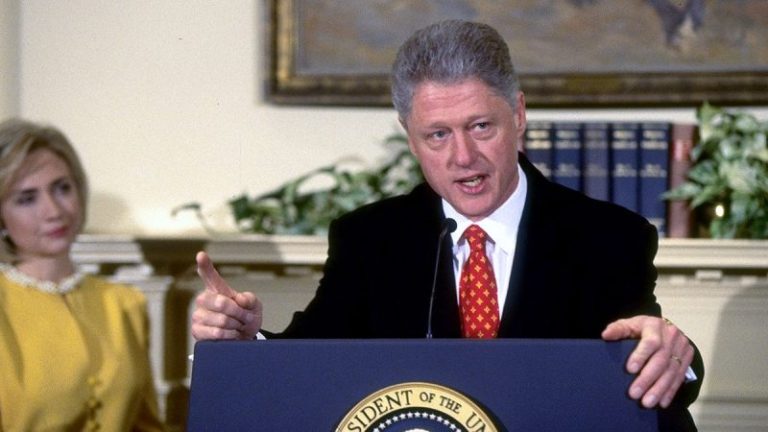
‘I want to say one thing to the American people: I’m going to say this again. I did not have sexual relations with that woman, Miss Lewinsky,’ Clinton said.

‘I never told anybody to lie. Not a single time. Never. These allegations are false, and I need to go back to work for the American people.’

Clinton was later impeached by the House, but the Senate voted against removing him from office.

A painting depicting Clinton wearing Lewinsky’s blue dress and sitting in a provocative pose was recorded on page EFTA00000862 of the Justice Department’s Epstein Files cache.

The painting was originally reported in 2019 to have been photographed inside Epstein’s Manhattan townhouse. It was not commissioned by Clinton and is not a White House image. Clinton himself also denied knowledge of the unique work.

Also on February 28 — this time in 1989 — federal authorities effectively shut down the financial firm that ultimately led to the Whitewater investigation. On February 28, 1989, federal authorities placed Madison Guaranty Savings & Loan, owned by Clinton ally Jim McDougal, into conservatorship. The entity became the genesis of Kenneth Starr’s Whitewater investigation, which later expanded to include the Lewinsky matter. While scrutinizing Bill and Hillary Clinton’s connection to the real estate dealings beginning in 1994 — for which they were both exonerated — Starr ultimately uncovered a presidential affair with an intern and the public deceit that followed.

What resulted in Clinton’s 1998 impeachment began more than a decade earlier, as Starr examined real estate transactions in a resort community project called Whitewater Estates in the Ozarks that involved a company formed by the future first couple and their politically-connected friends Jim and Susan McDougal.

The Clintons and McDougals wanted to sell lots for vacation homes, but in 1979 interest rates rose to nearly 20%, leaving potential buyers wary, according to the Encyclopedia of Arkansas.

Jim McDougal eventually took control of a rural bank later renamed Madison Guaranty Savings & Loan.

Starr ultimately investigated whether loans from Madison were improperly connected to Whitewater, and whether or what political influence benefitted McDougals financial dealings.

The Clintons were both investigated but never charged in connection with the bank or Whitewater, but the McDougals were, along with Clinton’s gubernatorial successor Gov. Jim Guy Tucker.

The Clinton Foundation did not immediately respond to a request for comment.

Related Article

House Oversight GOP rejects Hillary Clinton demand for public Epstein hearing: ‘No one is buying their claims’
This post appeared first on FOX NEWS

Former President Bill Clinton is telling the House Oversight Committee that he had ‘no idea’ of Jeffrey Epstein’s crimes as his deposition kicks off in Chappaqua, New York.

Clinton is in the hot seat for the committee’s bipartisan investigation into the late financier and sex trafficker for what is expected to be an all-day session of questions into his relationship with Epstein and his accomplice Ghislaine Maxwell.

‘Now, let me say what you’re going to hear from me. First, I had no idea of the crimes Epstein was committing. No matter how many photos you show me, I have two things that, at the end of the day, matter more than your interpretation of those 20-year-old photos,’ Clinton said, according to his prepared opening remarks.

‘I know what I saw and more importantly, what I didn’t see. I know what I did and more importantly, what I didn’t do. I saw nothing and I did nothing wrong.’

Clinton also warned lawmakers, ‘You’ll often hear me say that I don’t recall,’ but said he would not speculate when asked questions.

‘That might be unsatisfying, but I’m not going to say something I’m not sure of. This was all a long time ago, and I’m bound by my oath not to speculate or to guess. This is not merely for my benefit, but because it doesn’t help you for me to play detective 24 years later,’ Clinton said.

Meanwhile, House Oversight Committee Chairman James Comer, R-Ky., suggested he had an abundance of questions for the former president ahead of the deposition.

‘I think everyone’s seen that there are a lot of photos that have been released by the Department of Justice (DOJ) as well as the Epstein estate. There are a lot of email correspondence that included President Clinton,’ Comer said when asked what he needed to hear.

‘Secretary Clinton confirmed this yesterday: Jeffrey Epstein was in the White House 17 times while Bill Clinton was president. We know that Bill Clinton flew on Jeffrey Epstein’s plane at least 27 times. So those are questions that we’re going to ask.’

But Clinton said in his opening remarks that he would not have ridden on the plane if he knew the illicit things that took place there.

‘As someone who grew up in a home with domestic abuse, not only would I have not flown on his plane if I had any inkling of what he was doing — I would have turned him in myself and led the call for justice for his crimes, not sweetheart deals,’ Clinton said.

‘But even with 20/20 hindsight, I saw nothing that ever gave me pause. We are only here because he hid it from everyone so well for so long, and by the time it came to light with his 2008 guilty plea, I had long stopped associating with him.’

Comer also said questions would pertain to Epstein and to Clinton’s relationship with Ghislaine Maxwell, the late financier’s accomplice who is serving out a prison term in Texas after being convicted on federal sex trafficking charges.

Comer told reporters that his list of questions for Clinton had ‘increased’ in the wake of former Secretary of State Hillary Clinton’s own deposition before the committee on Thursday.

‘Mrs. Clinton deferred a lot of questions to her husband today. There were at least a dozen times when she said, ‘You’ll have to ask my husband that. I can’t answer that,” the chairman said.

He said that many of those deferrals had to do with the Clintons’ nonprofit work.

‘There are so many examples in the evidence the Department of Justice released, in correspondence where Epstein bragged about how involved he was initially in setting up the Clinton Global Initiative and the Clinton Foundation,’ he said.

‘We asked those questions to Secretary Clinton yesterday, and she kept saying she was in the Senate at that time. She wasn’t focused on it. ‘You’ll have to ask my husband.’ So a lot of the Clinton Global Initiative questions yesterday went unanswered because Mrs. Clinton deferred to her husband.’

The former president defended his wife during his opening statement as well, telling lawmakers that ‘before we start, I have to get personal.’

‘You made Hillary come in. She had nothing to do with Jeffrey Epstein. Nothing. She has no memory of even meeting him,’ Clinton said. ‘She neither traveled with him nor visited any of his properties. Whether you subpoenaed 10 people or 10,000, including her, was simply not right.’

Like Hillary Clinton did in her opening remarks, he said Epstein’s victims deserve both ‘justice’ and ‘healing,’ telling lawmakers that it was for them that he was appearing before the committee.

Clinton’s deposition began a few minutes after 11 a.m. on Friday, a person familiar with planning told Fox News Digital.

Comer told reporters on Thursday after Hillary Clinton’s sitdown that he expected the ordeal to be ‘even longer’ on Friday. 

Her deposition lasted roughly six hours from start to finish, with a brief lunch break in between.

Neither of the Clintons has been accused of anything related to Epstein’s crimes. But the former president’s name appears multiple times in documents released by the DOJ and the House Oversight Committee pertaining to the investigation into Epstein.

Like his wife’s testimony, Clinton will speak to the committee behind closed doors and under oath. 

The interview will be transcribed, with a video likely to be released within a week of its conclusion.

Related Article

Clintons cave: Comer says Bill and Hillary to testify in Epstein probe
This post appeared first on FOX NEWS

White House chief of staff Susie Wiles’ attorney in 2023 is disputing claims that he agreed to let the Biden-era FBI record a call with his client without her knowledge, according to a report.

‘If I ever pulled a stunt like that I wouldn’t – and shouldn’t – have a license to practice law,’ the unidentified attorney said, according to Axios. ‘I’m as shocked as Susie.’ 

The denial comes as scrutiny intensifies around the FBI’s use of subpoenas and investigative tools during special counsel Jack Smith’s Trump-related probes ahead of President Donald Trump’s 2024 re-election.

Reuters first disclosed the subpoenas Wednesday, reporting that the Biden FBI subpoenaed Wiles’ and now-FBI Director Kash Patel’s phone records in 2022 and 2023, when both were private citizens. Smith was investigating claims Trump worked to overturn the 2020 election and his handling of classified documents at his Mar-a-Lago, Florida, resort. 

At least 10 FBI employees were fired Wednesday over the matter, Fox News Digital previously learned. 

Amid the revelations, two FBI officials said that FBI agents recorded a phone call between Wiles and her attorney in 2023. Wiles’ attorney was aware the call was being recorded and consented, but Wiles was not informed, the officials claimed. 

The lawyer, whose name has not been publicly released, pushed back that he ‘categorically denies he allowed his client to be recorded by the FBI,’ according to Axios reporter Marc Caputo. 

Wiles reportedly ‘believes him & that the Biden-era FBI may have lied about it,’ Caputo wrote on X. 

Fox News Digital reached out to the White House and Wiles for comment, but did not immediately receive replies. Fox News Digital also reached out to the FBI for comment Friday morning. 

The report sparked conservatives and Trump allies to back the unidentified lawyer and balk at the case overall. 

‘I know the long time lawyer ….and I believe him – This is a violation of basic constitutional rights every American by right – has. We need accountability and we need action,’ Trump 2024 co-campaign manager Chris LaCivita posted to X. 

‘So the lawyer Biden’s FBI eavesdropped on during a call with Susie Wiles said he had no idea it happened,’ OutKick founder Clay Travis posted to X. ‘This is a huge story. Biden’s FBI spied on Trump’s campaign manager in the 2024 campaign.’ 

Wiles was reportedly stunned by the news of the subpoenas, with Axios reporting that she told associates Thursday, ‘I am in shock.’

Patel issued a similar statement on Wednesday.

‘It is outrageous and deeply alarming that the previous FBI leadership secretly subpoenaed my own phone records — along with those of now White House chief of staff Susie Wiles — using flimsy pretexts and burying the entire process in prohibited case files designed to evade all oversight,’ he said in a statement obtained by Fox News Digital. 

Related Article

JONATHAN TURLEY: Jack Smith’s secret surveillance of Patel and Wiles should alarm us all
This post appeared first on FOX NEWS

The ongoing standoff over Homeland Security funding is raising concerns about the potential impact on Homeland Security Investigations (HSI), the agency that has helped bring cases against high-profile figures, including Sean ‘Diddy’ Combs and Sinaloa cartel co-founder Joaquín ‘El Chapo’ Guzmán.

HSI is one of several agencies under the Department of Homeland Security (DHS) threatened by the ongoing government shutdown.

That branch of DHS acts as the investigative arm for Immigration and Customs Enforcement (ICE) — the agency that Democrats want to rein in and reform — and handles investigations into human and sex trafficking, drug trafficking, immigration-related crimes, child exploitation and several other areas.

Sen. Katie Britt, R-Ala., who was anointed the lead negotiator for Senate Republicans in the ongoing DHS funding back-and-forth, told Fox News Digital the agency’s work is ‘critically important.’

‘When you think about interior enforcement, I mean, HSI is a critical component of that,’ Britt said. ‘You look at what they’ve done, you look at the bad actors they’ve been able to hunt down and hold accountable for human trafficking, drug trafficking, sex trafficking, child pornography, trafficking, all kinds of things.’

Other big names whom HSI has played a role in investigating or indicting include R. Kelly, Josh Duggar, Sinaloa cartel co-founder Ismael ‘El Mayo’ Zambada and Jared Fogle.

While ICE and other immigration enforcement operations like HSI were funded in part through Republicans’ ‘big, beautiful bill,’ the lapse in ongoing appropriations could threaten supplies in the field and travel, hampering investigations already underway.

A DHS spokesperson told Fox News Digital that HSI was continuing to function during the shutdown, with arrests and investigations still happening. But as the current 14-day shutdown continues, delays in supply procurement and travel for ‘critical personnel to move around the country’ could be impacted.

‘Our national security and ability to get criminals, including pedophiles and other public safety threats, off the streets could be impacted the longer this Democratic shutdown continues,’ they said.

Senate Democrats and the White House have so far tried and failed to reach a deal to fund DHS after trading offers and counteroffers in a slow back-and-forth over the last two weeks.

Senate Minority Leader Chuck Schumer, D-N.Y., charged that ICE had been ‘unleashed without guardrails’ throughout the country.  

‘This is not border security, this is not law and order, this is chaos — created at the top and felt in so many of our neighborhoods,’ Schumer said.

And with lawmakers gone from Washington, D.C., for the weekend, the shutdown is guaranteed to stretch into its third week. Senate Democrats want stringent reforms to ICE, including requiring agents to obtain judicial warrants, unmask and provide thorough identification — all demands that are red lines for the Republicans and the White House, who fear that doing so would increase the chances of ICE agents being doxxed.

While Republicans and the administration raised concerns about HSI and other ICE functions, Sen. Chris Murphy, D-Conn., countered that from his understanding, ‘most everybody at HSI is gone.’

‘They’ve all been deployed to the interior,’ he told Fox News Digital. ‘Not many, if not most, redeployed to interior enforcement. So the administration has gutted HSI.’

‘My impression is that HSI has been one of the agencies that has been essentially turned into ICE Junior,’ Murphy said.

Related Article

DHS shutdown drags into week two as Iran threat, SOTU clash complicate Hill talks
This post appeared first on FOX NEWS

Rua Gold INC. (TSX: RUA,OTC:NZAUF) (NZ: RGI) (OTCQX: NZAUF) (‘Rua Gold’ or the ‘Company’) is pleased to announce that that its common shares have begun trading today on the OTCQX® Best Market under the symbol ‘NZAUF’. U.S. investors can find current financial disclosure and Real-Time Level 2 quotes for the company on www.otcmarkets.com.

Robert Eckford, CEO of Rua Gold, commented: ‘The graduation to the OTCQX Best Market is a natural progression aligned with the Company’s growth. This milestone coincides with the launch of an expanded exploration program at our gold-antimony project in the Reefton Goldfield on the South Island of New Zealand. This advancement enhances our visibility among U.S. investors, improves liquidity, and underscores our commitment to creating long-term shareholder value as we execute our 2026 growth plan.’

Upgrading to the OTCQX Best Market is an important step for companies seeking to provide transparent trading for their U.S. investors. For companies listed on a qualified international exchange, streamlined market standards enable them to utilize their home market reporting to make their information available in the U.S. To qualify for OTCQX, companies must meet high financial standards, follow best practice corporate governance and demonstrate compliance with applicable securities laws.

Along with trading on OTCQX, common shares of Rua Gold will continue to trade on the TSX and NZX.

About Rua Gold

Rua Gold is an exploration company, strategically focused on New Zealand. With decades of expertise, their team has successfully taken major discoveries into producing world-class mines across multiple continents. The team is focused on maximizing the asset potential of Rua Gold’s two highly prospective high-grade gold projects.

The Company controls the Reefton Gold District as the dominant landholder in the Reefton Goldfield on New Zealand’s South Island with over 120,000 hectares of tenements, in a district that historically produced over 2Moz of gold grading between 9 and 50g/t.

The Company’s Glamorgan Project solidifies Rua Gold’s position as a leading high-grade gold explorer on New Zealand’s North Island. This highly prospective project is located within the North Island’s Hauraki district, a region that has produced an impressive 15Moz of gold and 60Moz of silver. Glamorgan is adjacent to OceanaGold Corporation’s biggest gold mining project, Wharekirauponga.

FOR FURTHER INFORMATION PLEASE CONTACT:
Robert Eckford
Phone: (604) 655-7354
Email: reckford@ruagold.com

Neither the TSX nor its Regulation Services Provider (as that term is defined in the policies of the TSX) accepts responsibility for the adequacy or accuracy of this release.

Forward-Looking Information

This news release includes certain statements that may be deemed ‘forward-looking statements’. All statements in this news release, other than statements of historical facts, that address events or developments that the Company expects to occur, are forward-looking statements. Forward-looking statements are statements that are not historical facts and are generally, but not always, identified by the words ‘expects’, ‘plans’, ‘anticipates’, ‘believes’, ‘intends’, ‘estimates’, ‘projects’, ‘potential’ and similar expressions, or that events or conditions ‘will’, ‘would’, ‘may’, ‘could’ or ‘should’ occur and specifically include statements regarding: the Company’s strategies, expectations, planned operations or future actions including but not limited to exploration programs at its New Zealand properties and the graduation to the OTCQX. Although the Company believes the expectations expressed in such forward-looking statements are based on reasonable assumptions, such statements are not guarantees of future performance and actual results may differ materially from those in the forward-looking statements.

Investors are cautioned that any such forward-looking statements are not guarantees of future performance and actual results or developments may differ materially from those projected in the forward-looking statements. A variety of inherent risks, uncertainties and factors, many of which are beyond the Company’s control, affect the operations, performance and results of the Company and its business, and could cause actual events or results to differ materially from estimated or anticipated events or results expressed or implied by forward looking statements. Some of these risks, uncertainties and factors include: general business, economic, competitive, political and social uncertainties; risks related to the effects of the Russia-Ukraine war; risks related to climate change; operational risks in exploration, delays or changes in plans with respect to exploration projects or capital expenditures; the actual results of current exploration activities; conclusions of economic evaluations; changes in project parameters as plans continue to be refined; changes in labour costs and other costs and expenses or equipment or processes to operate as anticipated, accidents, labour disputes and other risks of the mining industry, including but not limited to environmental hazards, flooding or unfavorable operating conditions and losses, insurrection or war, delays in obtaining governmental approvals or financing, and commodity prices. This list is not exhaustive of the factors that may affect any of the Company’s forward-looking statements and reference should also be made to the Company’s documents filed under its SEDAR+ profile at www.sedarplus.ca for a description of additional risk factors.

Forward-looking statements are based on the beliefs, estimates and opinions of the Company’s management on the date the statements are made. Except as required by applicable securities laws, the Company undertakes no obligation to update these forward-looking statements in the event that management’s beliefs, estimates or opinions, or other factors, should change.

To view the source version of this press release, please visit https://www.newsfilecorp.com/release/285548

News Provided by TMX Newsfile via QuoteMedia

This post appeared first on investingnews.com

(TheNewswire)

Toronto, Ontario TheNewswire – February 27, 2026 Juggernaut Exploration Ltd. (TSX-V: JUGR) (OTCPK: JUGRF) (FSE:4JE) (the ‘Company’ or ‘Juggernaut’) is pleased to announce that it has entered into an agreement with Stifel Canada (the ‘Underwriter’) to act as sole bookrunner and underwriter in connection with a ‘bought deal’ private placement offering by the Company of 3,906,250 units of the Company (the ‘Units’) at an issue price of

$2.56 per Unit (the ‘Offering Price‘), for aggregate gross proceeds of $10,000,000 (the ‘Offering‘). Each Unit will be comprised of one common share (a ‘FT Share‘), and one-half of one common share purchase warrant (each whole warrant, a ‘Warrant‘). Each Warrant shall entitle the holder thereof to purchase one common share in the capital of the Company at an exercise price of $2.08, for a period of 24 months following the Closing Date (as defined below). The FT Shares and Warrants are intended to qualify as ‘flow-through shares’ as defined in subsection 66(15) of the Income Tax Act (Canada) (the ‘Tax Act‘).


The Company has granted the Underwriter an option to sell such number of additional Units as is equal to 15% of the number of Units sold under the Offering at the Issue Price (the ‘Underwriter’s Option‘). The Underwriter’s Option will be exercisable, in whole or in part, at any time up until 48 hours prior to the closing date of the Offering (the ‘Closing Date‘).


The Offering is expected to close on or about March 19, 2026, and is subject to certain conditions including the receipt of all necessary approvals such as the approval of the TSX Venture Exchange (the ‘Exchange‘).

The gross proceeds from the Units will be used to incur exploration expenses that qualify as ‘Canadian exploration expenses’ as defined in subsection 66.1(6) of the Tax Act, ‘flow-through critical mineral mining expenditures’ as defined in subsection 127(9) of the Tax Act for purposes of the mineral exploration tax credit, and for individual subscribers of Units that are resident in British Columbia, ‘BC flow-through mining expenditures’ as defined in subsection 4.721(1) of the Income Tax Act (British Columbia) (the ‘Qualifying Expenditures‘) on the Company’s flagship Big One Gold Project, located in British Columbia, Canada. Such expenses will be incurred on or before December 31, 2027, and renounced to the subscribers with an effective date no later than December 31, 2026.


In connection with the Offering, certain purchasers of Units intend to subsequently (i) donate some or all of such Units to registered charities, who may sell such Units to purchasers arranged by the Underwriter, and/or (ii) sell some or all of such Units to purchasers arranged by the Underwriter, in each case on the Closing Date (such Units described in (i) and (ii), being the ‘Re-Offer Units‘). Sales of Re-Offer Units may be made to purchasers located in (i) each of the provinces of Canada, other than Quebec, pursuant to the Listed Issuer Financing Exemption (as defined below), (ii) the United States pursuant to available exemptions from the registration requirements of applicable United States securities laws, and (iii) such other jurisdictions provided it is understood that no prospectus filing or comparable obligation, ongoing reporting requirement or requisite regulatory or governmental approval arises in such other jurisdictions


Subject to compliance with applicable regulatory requirements and in accordance with National Instrument 45-106 – Prospectus Exemptions (‘NI 45-106‘), the Units will be offered for sale to purchasers resident in Canada

and/or other qualifying jurisdictions pursuant to the listed issuer financing exemption under Part 5A of NI 45-106 (the ‘Listed Issuer Financing Exemption‘). As the Offering is being completed pursuant to the Listed Issuer Financing Exemption, the securities underlying the Units issued pursuant to the Offering will not be subject to a hold period pursuant to applicable Canadian securities laws. There is an offering document related to the Offering that can be accessed under the Company’s issuer profile on SEDAR+ at www.sedarplus.ca and on the Company’s website at juggernautexploration.com. Prospective investors should read the offering document before making an investment decision.


In consideration for the services provided to the Company in connection with the Offering, the Underwriter will be entitled to receive a cash commission equal to 6.0% of the gross proceeds raised under the Offering (the ‘Cash Commission‘) and such number of broker warrants (‘Broker Warrants‘) as is equal to 6.0% of the number of Units sold under the Offering (including the Underwriter’s Option). Each Broker Warrant will entitle the holder thereof to acquire one common share of the Company at a price of C$1.81 for a period of 24 months following the closing date of the Offering. For the avoidance of doubt, the Cash Commission will be paid from the Company’s cash on hand and not from the gross proceeds received by the Company under the Offering.


This news release does not constitute an offer to sell or a solicitation of an offer to buy nor shall there be any sale of any of the securities in any jurisdiction in which such offer, solicitation or sale would be unlawful, including any of the securities in the United States. The securities described herein have not been, and will not be, registered under the United States Securities Act of 1933, as amended (the ‘1933 Act‘) or any state securities laws and may not be offered or sold within the United States or to, or for account or benefit of, U.S. Persons (as defined in Regulation S under the 1933 Act) unless registered under the 1933 Act and applicable state securities laws, or an exemption from such registration requirements is available.


Juggernaut Attending The PDAC

To learn more about Juggernaut’s exciting new Big One discovery, we would like to cordially invite you to visit us at the PDAC, where our entire technical team will be in attendance at booth # 3232, Investors Exchange South Building, Sunday, March 1st, until Wednesday, March 4th, adjacent to our sister company, Goliath Resources. The PDAC is held at the Metro Toronto Convention Centre at 255 Front Street West, Toronto.

PDAC provides a unique venue at the world’s premier mining convention for Juggernaut to showcase its exciting new discovery at the Big One Property located in the Golden Triangle of B.C. The latest discoveries from around the world are featured along with maps, charts, and technical information.


About Juggernaut Exploration Ltd.


Juggernaut Exploration Ltd. is an explorer of precious metals projects in the prolific Golden Triangle of northwestern British Columbia. Its projects are located in globally recognized geological settings and in geopolitically stable jurisdictions, making them amenable to mining in Canada. Juggernaut is a member and active supporter of CASERM, a collaborative venture between the Colorado School of Mines and Virginia Tech. Juggernaut’s key strategic cornerstone shareholder is Crescat Capital.

For more information, please contact:

Juggernaut Exploration Ltd.

Dan Stuart

Chief Executive Director, Director Tel: +(604) 559-8028

www.juggernautexploration.com

This press release contains statements that constitute ‘forward-looking information’ (‘forward-looking information‘) within the meaning of the applicable Canadian securities legislation. All statements, other than statements of historical fact, are forward-looking information and are based on expectations, estimates and projections as at the date of this news release. Any statement that discusses predictions, expectations, beliefs, plans, projections, objectives, assumptions, future events or performance (often but not always using phrases such as ‘expects’, or ‘does not expect’, ‘is expected’, ‘anticipates’ or ‘does not anticipate’, ‘plans’, ‘budget’, ‘scheduled’, ‘forecasts’, ‘estimates’, ‘believes’ or ‘intends’ or variations of such words and phrases or stating that certain actions, events or results ‘may’ or ‘could’, ‘would’, ‘might’ or ‘will’ be taken to occur or be achieved) are not statements of historical fact and may be forward-looking information. Forward-looking statements in this news release include statements regarding the Offering (including the completion of the Offering on the terms and timeline as announced or at all, the tax treatment of the securities comprising the Units, the timing to incur and renounce all Qualifying Expenditures in favour of the subscribers, and the use of proceeds of the Offering), and the Company’s ability to obtain all regulatory approvals, including the approval of the Exchange. In disclosing the forward-looking information contained in this press release, the Company has made certain assumptions. Although the Company believes that the expectations reflected in such forward-looking information are reasonable, it can give no assurance that the expectations of any forward-looking information will prove to be correct. Known and unknown risks, uncertainties, and other factors which may cause the actual results and future events to differ materially from those expressed or implied by such forward-looking information. Such factors include but are not limited to: compliance with extensive government regulations; domestic and foreign laws and regulations adversely affecting the Company’s business and results of operations; and general business, economic, competitive, political and social uncertainties. Accordingly, readers should not place undue reliance on the forward-looking information contained in this press release. Except as required by law, the Company disclaims any intention and assumes no obligation to update or revise any forward-looking information to reflect actual results, whether as a result of new information, future events, changes in assumptions, changes in factors affecting such forward-looking information or otherwise.

Neither the TSX Venture Exchange nor its Regulation Services Provider (as that term is defined in the policies of the TSX Venture Exchange) accepts responsibility for the adequacy or accuracy of this release.

THIS NEWS RELEASE IS INTENDED FOR DISTRIBUTION IN CANADA ONLY AND IS NOT FOR DISTRIBUTION TO UNITED STATES NEWSWIRE SERVICES OR DISSEMINATION IN THE UNITED STATES

Copyright (c) 2026 TheNewswire – All rights reserved.

News Provided by TheNewsWire via QuoteMedia

This post appeared first on investingnews.com

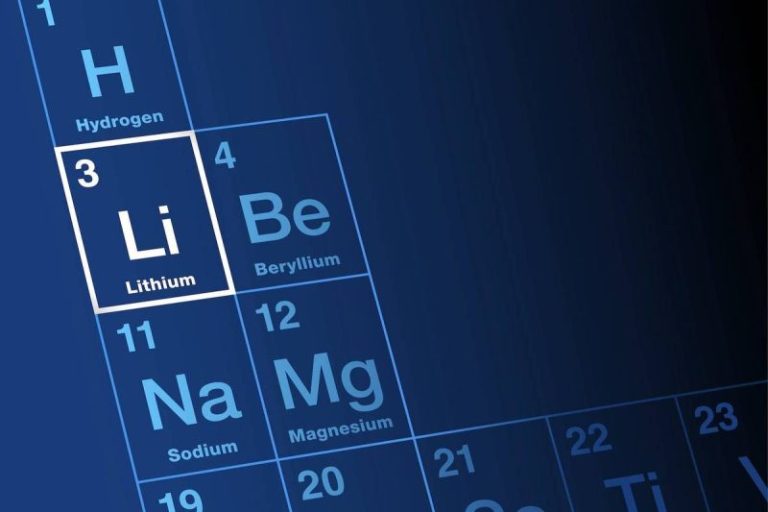
The UK has entered commercial lithium production for the first time as Geothermal Engineering Ltd (GEL) began operations in its plant at Cornwall, anchoring the government’s hopes of a domestic battery metals supply chain.

The Redruth-based facility marks the country’s first commercial-scale output of lithium, a metal essential for electric vehicle batteries and energy storage systems.

Initial production is set at 100 tons per year, with plans to expand to 1,500 tons annually within several years and to more than 18,000 tons over the next decade. That long-term expansion would require an estimated £640 million, or around US$860 million, in additional investment.

Beijing’s use of export restrictions on critical materials last year further sharpened the country’s concerns about supply vulnerability. China currently controls about 60 percent of global lithium processing capacity and dominates much of the downstream battery supply chain.

The UK government has set a target to produce 50,000 tons of lithium domestically by 2035. Demand is expected to surge as electric vehicle adoption expands and grid-scale energy storage grows.

GEL’s project combines lithium extraction with geothermal energy production. The company has drilled nearly three miles underground into granite formations in Cornwall, circulating mineral-rich fluids that are both hot enough to generate electricity and contain dissolved lithium.

The geothermal plant, also switched on this week, will power the lithium extraction process. The excess electricity is also expected to generate enough electricity to supply up to 10,000 homes.

GEL founder Ryan Law said pairing lithium production with geothermal power is critical to cost control. “We can easily compete with what’s coming from China,” Law told the Financial Times.

The project has cost approximately US$67.5 million so far, funded through private investors and US$20.25 million from the European Development Fund. The UK government also provided a US$2.43 million grant, covering half the cost of the initial lithium extraction system.

Cornwall has emerged as the center of Britain’s lithium ambitions. Several companies are working to bring projects online, though timelines have shifted amid volatile lithium prices.

For instance, Cornish Lithium, which has been producing small quantities of lithium hydroxide samples for potential customers since October and is targeting a commercial plant by 2029, had reduced its 2030 production target from 25,000 tons annually to 20,000 tons.

Meanwhile, British refiner Green Lithium has also pushed back the opening of its Teesside commercial facility to around 2029, adopting what co-founder Guy Hatcher called a “more phased development strategy.”

Securities Disclosure: I, Giann Liguid, hold no direct investment interest in any company mentioned in this article.

This post appeared first on investingnews.com

Combined company is well-capitalized with an exceptional management team and portfolio of gold assets in the Eeyou Istchee James Bay region

Sirios Resources Inc. (TSXV: SOI,OTC:SIREF) (OTCQB: SIREF) (‘Sirios’) and OVI Mining Corp. (‘OVI’) are pleased to announce the completion of their previously announced business combination by way of a court approved plan of arrangement under the Business Corporations Act (British Columbia) (the ‘Transaction’). Under the Transaction, Sirios acquired all of the common shares of OVI (each, an ‘OVI Share’) outstanding immediately prior to the effective time of the Transaction, which resulted in OVI becoming a wholly-owned subsidiary of Sirios.

Following completion of the Transaction, each former holder of OVI Shares is entitled to receive 2.34 common shares of Sirios (each, a ‘Sirios Share‘) in exchange for each common share of OVI held immediately prior to the effective time of the Transaction.

Concurrent with the completion of the Transaction, Jean-Félix Lepage has been appointed Chief Executive Officer of Sirios, replacing Sirios founder, Dominique Doucet, who will transition to Executive Chairman and Head of Exploration. In addition, Sean Roosen and Laurence Farmer have joined the board of directors of Sirios (the ‘Board‘), adding deep Québec mining and capital markets expertise to the Sirios team.

Mr. Lepage has over 15 years of experience in mining and managing operations, projects, and development activities. Prior to becoming CEO of OVI, he was Vice-President of Projects at O3 Mining Inc., where he led the Marban Project though the study and development process. His past experience also includes several different operational roles at Newmont Corporation, including managing the underground operations at the Eleonore Mine. Mr. Lepage obtained his Bachelor of Mining Engineering from Université Laval and holds a college technical degree in mineral processing from CEGEP de Thetford.

Jean-Félix Lepage, incoming CEO of Sirios, stated: ‘I am honoured to lead Sirios Resources as we enter this exciting new chapter. The combination of Sirios and OVI creates a stronger, well-capitalized company with an exceptional portfolio of gold assets in the Eeyou Istchee James Bay region. I look forward to working with our talented team and newly strengthened board to advance our exploration and development programs and deliver value for our shareholders.’

Dominique Doucet, former CEO of Sirios, stated: ‘After founding and leading Sirios for many years, I am proud to see the company take this significant step forward. This transaction brings together two complementary teams and asset portfolios, strengthening our position in the James Bay gold camp. In my new role as Executive Chairman and Head of Exploration, I remain deeply committed to Sirios and look forward to focusing my efforts on advancing our exploration programs and supporting Jean-Félix and the team in building on the foundation we have established.’

Board of Directors

The Board is led by Executive Chairman Dominique Doucet, and now includes Sean Roosen and Laurence Farmer, as well as Robert Ménard, Colinda Parent and Guy Le Bel. Luc Cloutier has resigned from the Board. Sirios would like to express its sincere gratitude for his years of service.

Dominique Doucet, former CEO of Sirios, stated: ‘On behalf of the Board, I would like to recognize and express my profound gratitude for Luc’s unwavering commitment and dedication to Sirios since its founding in 1994. Luc’s contributions have left an lasting mark on Sirios, and his legacy will continue to shape our path forward. On behalf of the entire Sirios team, we extend our heartfelt appreciation and wish him every success in his future endeavours.’

Mr. Roosen is the founder and Executive Chairman of Osisko Development Corp., and former CEO of OR Royalties Inc. As founder, President, Chief Executive Officer, and Director of Osisko Mining Corporation, Mr. Roosen was responsible for developing the strategic plan for the discovery, financing, and development of the Canadian Malartic mine. Recognized as one of the ‘Top 20 Most Influential Individuals in Global Mining,’ in 2017, he brings unmatched industry vision and strategic leadership.

Mr. Farmer is the General Counsel and VP Strategic Development of Osisko Development Corp. and the Chief Executive Officer of Electric Elements Mining Corp., prior to which he was Senior Counsel of OR Royalties Inc. Prior to joining the Osisko Group, Mr. Farmer worked in investment banking at RBC Capital Markets in London and, before that, practiced as a corporate lawyer with Norton Rose Fulbright LLP in London, England and Montréal, Canada, and brings strong transactional expertise and strategic insight into global resource development.

Information for Former OVI Shareholders

To receive the Sirios Shares to which they are entitled under the Transaction, former registered shareholders of OVI must complete, sign, date and return the letter of transmittal mailed to each OVI shareholder prior to closing. The letter of transmittal is also available on SEDAR+ (www.sedarplus.ca) under OVI’s issuer profile. Former shareholders whose OVI Shares are registered in the name of a broker, investment dealer, bank, trust company or other intermediary should contact that intermediary for assistance in depositing their OVI Shares and follow its instructions.

The Transaction was unanimously approved by shareholders of OVI at a special meeting held on February 18, 2026 (the ‘Meeting‘). Further information about the Transaction is set forth in the joint news release of Sirios and OVI dated December 11, 2025 and the management information circular prepared by OVI in respect of the Meeting which was mailed to shareholders of OVI and filed on SEDAR+ (www.sedarplus.ca) under OVI’s issuer profile.

OVI has applied to cease to be a reporting issuer under applicable Canadian securities laws.

Pursuant to the Transaction, Sirios will issue an aggregate of 131,905,594 Sirios Shares. All 1,866,000 options to purchase OVI Shares outstanding immediately prior to the effective time of the Transaction, whether or not vested, were exchanged for 4,366,440 options to acquire Sirios Shares, with an exercise price equal to approximately $0.05641 per Sirios Share, subject to rounding on the exercise thereof in accordance with the plan of arrangement and which expire on November 1, 2030.

OVI owns a portfolio of properties located in the James Bay region of Québec, including a 100% interest in the Corvet Est and PLEX gold projects. Certain of OVI’s properties are subject to royalties and contingent cash payments, which have been assumed indirectly by Sirios as a result of the Transaction.

Early Warning Disclosure

Prior to the completion of the Transaction, Sirios held no OVI Shares. Following the completion of the Transaction, Sirios holds all of the issued and outstanding OVI Shares. An early warning report will be filed by Sirios on SEDAR+ (www.sedarplus.ca) under OVI’s issuer profile in accordance with applicable securities laws. To obtain a copy of the early warning report, please contact the CEO of Sirios 438-454-5636 or info@sirios.com. Sirios’s head office is located at 1400 Marie-Victorin, Bureau 210, Saint-Bruno-de-Montarville, Québec, J3V 6B9.

Advisors and Counsel

Bennett Jones LLP acted as legal counsel to OVI in connection with the Transaction. Mills Dunlop Capital Partners acted as financial advisor to OVI.

Stein Monast LLP acted as legal counsel to Sirios in connection with the Transaction.

About Sirios Resources Inc.

Sirios Resources Inc. (TSXV: SOI,OTC:SIREF) (OTCQB: SIREF) (www.sirios.com) is a Québec-based mineral exploration company focused on developing its portfolio of high-potential gold properties in the Eeyou Istchee James Bay region of Canada.

For more information, please contact:

Sirios Resources Inc.
Jean-Félix Lepage, CEO
438-454-5636
info@sirios.com
www.sirios.com

OVI Mining Corp.
Jean-Félix Lepage, CEO
438-454-5636
jflepage@ovimining.com
www.ovimining.com

Cautionary Note Regarding Forward-Looking Information

This news release contains ‘forward-looking information’ within the meaning of applicable Canadian securities legislation. All statements, other than statements of historical fact, are forward-looking statements and are based on expectations, estimates and projections as at the date of this news release. Any statement that involves discussions with respect to predictions, expectations, beliefs, plans, projections, objectives, assumptions, future events or performance (often but not always using phrases such as ‘expects’, or ‘does not expect’, ‘is expected’, ‘anticipates’ or ‘does not anticipate’, ‘plans’, ‘budget’, ‘scheduled’, ‘forecasts’, ‘estimates’, ‘believes’ or ‘intends’ or variations of such words and phrases or stating that certain actions, events or results ‘may’ or ‘could’, ‘would’, ‘might’ or ‘will’ be taken to occur or be achieved) are not statements of historical fact and may be forward-looking statements.

In this news release, forward-looking statements relate to, among other things, statements regarding: the anticipated benefits of the Transaction, including potential synergies resulting from combining Sirios and OVI and the creation of a stronger, well-capitalized company; the enhanced portfolio of gold assets in the Eeyou Istchee James Bay region; the expected advancement of exploration and development programs; the ability to deliver value for shareholders; future exploration results and the potential for resource growth; the expectations for the combined entity’s board, management team and operations; the roles and responsibilities of management, including those of Mr. Lepage, Mr. Doucet, Mr. Roosen and Mr. Farmer; the filing of an early warning report and the ceasing of OVI’s status as a reporting issuer; and any other statements that are not historical facts.

Forward-looking statements are based on certain assumptions and analyses made by Sirios and OVI in light of the experience and perception of historical trends, current conditions, and expected future developments, and other factors they believe are appropriate. These forward-looking statements are not guarantees of future results and involve risks and uncertainties that may cause actual results to differ materially from the potential results discussed in the forward-looking statements.

Risks and uncertainties that may cause such differences include, but are not limited to: fluctuations in the price of gold and other commodities; general economic, market and business conditions; the inherent risks associated with mineral exploration, development and mining operations; risks relating to the integration of Sirios and OVI and the realization of anticipated benefits from the Transaction; the volatility of the capital markets and market conditions in general; changes in national and local government legislation, taxation, controls and regulations; environmental risks and hazards; the speculative nature of mineral exploration; risks associated with obtaining and maintaining necessary licences, permits and authorizations and complying with permitting requirements; title matters; community and Indigenous relations; uncertainty in the estimation of mineral resources; competition for, among other things, capital, undeveloped lands and skilled personnel; risks relating to insufficient funding and the requirement for additional capital; risks relating to climate change and extreme weather events; the reliance on key personnel; the potential for conflicts of interest among certain officers and directors; and the other risks described in the continuous disclosure documents of Sirios filed with the Canadian securities regulatory authorities available on SEDAR+ at www.sedarplus.ca.

Sirios and OVI believe that the expectations reflected in forward-looking statements are reasonable, but no assurance can be given that these expectations will prove to be correct. As such, readers should not place undue reliance on the forward-looking statements and information contained in this news release. These forward-looking statements are made as of the date of this news release and, except as required under applicable securities legislation, Sirios and OVI assume no obligation to update or revise them to reflect new events or circumstances.

Neither the TSX Venture Exchange nor its Regulation Services Provider (as that term is defined in the policies of the TSX Venture Exchange) accepts responsibility for the adequacy or accuracy of this release.

To view the source version of this press release, please visit https://www.newsfilecorp.com/release/285631

News Provided by TMX Newsfile via QuoteMedia

This post appeared first on investingnews.com

Escalating tensions between the United States and Iran are reviving a risk energy markets have long feared: a potential closure of the Strait of Hormuz, the narrow Gulf passage that carries roughly 20 percent of global LNG trade and 25 percent of seaborne oil.

New modelling from energy analytics firm ICIS suggests that a three-month disruption would send European benchmark gas prices sharply higher and strain storage levels heading into winter.

US-Iran nuclear talks are continuing this week after previous meetings failed to produce a breakthrough.

Meanwhile, the US has increased its military posture in the Gulf region, redeploying a carrier strike group to the Northern Arabian Sea. Iranian Revolutionary Guard forces have conducted drills in the Strait of Hormuz and tested a temporary blockage of the sea passage, with officials publicly raising the possibility of closing the route to international traffic.

Oil markets have already begun reacting to the rising geopolitical risk.

Prices climbed to seven-month highs as traders positioned ahead of renewed US-Iran nuclear talks. US crude futures rose to as high as US$67.28 per barrel to start this week, while Brent crude reached US$72.50, its highest level since July 31, 2025, before easing later in the session.

Disruption scenario points to sharp market shock

The ICIS postures that the strategic importance of the strait is difficult to overstate. A prolonged closure would disrupt a quarter of global seaborne oil flows and a fifth of LNG trade. For Europe, the most immediate impact would be the loss of Qatari LNG volumes that transit the Gulf.

To assess the potential impact, ICIS modelled two scenarios: a base case reflecting current market conditions, and a disruption case assuming no contracted Qatari LNG imports to Europe until the end of May—a 102-day halt combined with a 131 terawatt-hour (TWh)reduction in spot LNG volumes over 90 days.

Under the disruption scenario, the Dutch TTF front-month contract, which is Europe’s gas benchmark, would jump toward 92 euros per megawatt hour, averaging around 86 €/MWh during the 90-day blockade.

This price point hovers substantially above the base case and far exceeds the price response in ICIS’ cold-winter scenario, which resulted in roughly a 20 percent increase in some Eastern European markets.

Furthermore, a three-month interruption of Qatari LNG would represent a supply shock of roughly 14 percent during the period, even before accounting for missing spot cargoes.

According to ICIS, that scale of disruption would likely drive the European gas balance into shortage territory.

“We see Europe has simultaneously allowed strategic buffers like gas storage levels to erode to dangerously low levels at a critical moment in global affairs,” said ICIS editor Ghassan Zumot.

Even with elevated prices, not all demand in Central and Eastern Europe could be easily met while still complying with mandated EU storage targets. In the disruption scenario, end-of-winter storage levels fall to about 244 TWh, compared with 275 TWh in the base case .

Under such conditions, the ICIS noted that competition between Asia and Europe for flexible LNG cargoes would also intensify.

Its modeling suggests that the marginal price during the blockade would be determined by the relative willingness-to-pay of Asian power systems during the summer cooling season versus Europe’s need to secure LNG for storage injections ahead of winter.

Volatile market meets gulf risk

The prospect of disruption in the Gulf adds fresh uncertainty to energy markets that have yet to stabilize.

“Throughout the year, prices have continued the downtrend they began in April (2024) as OPEC+ continued to hike output and China’s economy continued to struggle under the weight of a flailing property sector, downbeat consumer confidence, overindebted local governments and flagging external demand,” he added.

US President Donald Trump’s on-again, off-again tariffs also injected uncertainty into markets. “We can see that Trump’s ‘Liberation Day’ tariffs pushed prices down to a level from which they’ve not recovered from, barring a spike in June as a result of the 12 day Iran-Israel war,” Cunningham said.

Despite current perceptions of abundant oil supply with floating inventories hovering around a billion barrels, analysts caution that geopolitical disruptions could quickly alter the balance.

“The real question is not if oil and gas production will increase, but by how much,” Cunningham said, noting that production forecasts have been revised higher in response to OPEC+ output hikes and strong US LNG demand. At the same time, tensions within OPEC+ and sanctions on Russia could complicate supply trajectories.

For Europe, the immediate vulnerability lies in gas. The continent has made significant strides since 2022 in diversifying supply routes and expanding LNG import infrastructure.

However, a closure of the Strait of Hormuz would instantly test those gains.

Securities Disclosure: I, Giann Liguid, hold no direct investment interest in any company mentioned in this article.

This post appeared first on investingnews.com