
Archive

March 26, 2026

Browsing

Part 3 of a five-part Fox News Digital series investigating the House of Singham documents the “Propaganda Work” that Mao Zedong taught as critical to winning the People’s War. This reporting includes analysis using cutting-edge technology, including large-language modeling.

Early Tuesday, CodePink professional activist Olivia DiNucci raised her fist as she stood on the deck of a boat renamed “Granma 2.0,” in a tribute to the yacht Fidel Castro’s guerrillas used to launch the Cuban Revolution in 1956.

Standing behind a banner reading “LET CUBA LIVE” as the boat arrived at the port of Havana, DiNucci, who normally organizes protests in Washington, D.C., mugged for the cameras with her fellow revolutionaries, chanting and pumping their fists in the air, as camera crews rolled.

Luis De Jesús, who writes for a site called BreakThrough News, recorded the arrival, part of days of coverage promoting the cause of pro-communism activists, including the Irish hip-hop trio Kneecap, and packaging the week’s activities not just as activism, but as revolutionary political “resistance” against the U.S. “empire.”

By afternoon, BreakThrough News posted a video of De Jesús’ report on the boat’s arrival, with a beaming DiNucci on board. Other pro-communist media platforms turned the staged event into a media moment, from the Cuban News Agency to Brazil de Fato.

The scene offered a real-time glimpse of how a network built by an American-born, China-based tech tycoon, Neville Roy Singham, turns activism into propaganda and then propaganda into political and psychological weapons. In this case, the story of the Granma 2.0 framed Cuba as a victim of the imperialist U.S., and Cuba’s communist benefactor and trading partner – China – as a liberator, providing rice to a hungry citizenry.

As he fought the People’s War in the late 1930s in China, infamous communist leader Mao Zedong emphasized the importance of “Propaganda Work” and “the practice of changing reality.”

Decades later, Chinese Premier Xi Jinping announced a strategy of “telling China’s story well.”

POWER COUPLE OF CHAOS: HOW A TYCOON AND ACTIVIST BUILT A ‘REVOLUTIONARY BASE’ AT THE HOUSE OF SINGHAM

Last fall, pro-China academics, like Vijay Prashad, a trusted communist in Singham’s inner circle, spoke at a conference of the Global South Academic Forum about creating a “New World Information and Communication Order,” an idea popularized in the 1980s by Third World countries now called the “Global South.” 

The conference was co-sponsored by Singham, Prashad’s Tricontinental Ltd. think tank and the Shanghai-based East China Normal University, and administered by the Chinese Communist Party. The university features a School of Marxism and teaches “Marxist journalism.” Singham, Prashad and conference attendees closed the conference, standing at attention as “The Internationale,” a communist anthem played, attendees pumping their fists in the air in solidarity.

A Fox News Digital investigation found that the “new information” strategy operates through a network of organizations that produce, fund and amplify messaging across borders. 

Fox News Digital has identified at least 200 organizations in Singham’s network of about 2,000 organizations that directly work on propaganda that parrots the anti-American messaging of the Chinese Communist Party but is dramatically homegrown in digital shops from New York City to Los Angeles.

The investigation found that three Singham-linked U.S. nonprofits sent a total of $9.1 million in seven payments to a pro-China propaganda firm, Shanghai Maku Cultural Communications Co. Ltd. The payments haven’t been reported before.

Using large-language models, Fox News Digital analyzed 223 transactions that moved $591 million in total across five continents from 2017 through 2025, the latest year for which figures are available, in the Singham network and found the money flows through five concentric rings of an ideological pipeline that spreads pro-China propaganda.

Eleven U.S. nonprofit organizations form a core hub of the work that pumps pro-China, anti-America propaganda into the world, with a total of about $401 million flowing from Singham and his network into these organizations. The organizations didn’t respond to requests for comment.

Fox News Digital previously documented $278 million that flowed directly from Singham into organizations that “sow discord” in the U.S., as House Ways and Means Chair Jason Smith put it recently at a hearing on foreign malign influence in the nonprofit industry. The rest went through layers of funding.

The 11 nonprofits and their total revenue from within the Singham network, including direct contributions from Singham himself, make most of these organizations well-funded: 

  • BreakThrough BT Media: $3.5 million, with $1.1 million directly from Singham
  • CodePink Women for Peace: $1.8 million, with $1.3 million from SIngham
  • Inter-Religious Foundation for Community Organization Inc.: $420,000
  • Justice and Education Fund Inc.: $74.2 million, with $68.7 million from Singham
  • People’s Dispatch: $1.9 million
  • People’s Forum Inc.: $28 million, with $22.4 million from Singham
  • People’s Support Foundation: $181.8 million, with $167.5 from Singham
  • People’s Welfare Association: $70 million
  • Progress Unity Fund: $442,524, with additional revenues from other sources
  • Tricontinental Ltd.: $16.8 million from Singham
  • United Community Fund: $21.8 million

Mao’s strategy relied on embedding revolutionary actors within social, cultural, labor and educational organizations to shape public consciousness, normalize radical narratives and gradually erode the legitimacy of the state from within. 

Similarly, experts say, Singham’s network cultivates activist ecosystems, using nonprofits and advocacy groups as force multipliers and framing local political and social conflicts as part of a broader systemic struggle. 

That same dynamic is visible in real time, as protests, trips and political events are filmed, packaged and circulated as part of a broader narrative. DiNucci is a key figure, for example, regularly getting filmed and then broadcast on Singham network social media channels, interrupting the dinners, hearings and events of Trump administration officials.

In this model, disruption and polarization aren’t incidental but strategic, designed to weaken societal cohesion and authority over time, precisely the conditions Mao argued are necessary for victory against a stronger adversary.

“There is a war waging for the brains of Americans. It’s critical that America shore up its defenses before the nation is hijacked by confusion, manipulation and malign narratives,” psychologist Orli Peter told Fox News Digital.

RED WEALTH, DARK MONEY: HOW AN AMERICAN TYCOON DEPLOYS MAO’S PLAYBOOK AGAINST THE WEST

‘Information Laundering Operation’

A Fox News Digital investigation, scouring scores of financial filings, writings and social media posts, shows not only money moving from Singham-funded entities into U.S. nonprofits, but these nonprofits in turn funding media production, political education and organizing campaigns that promote the narrative of the Chinese Communist Party. The U.S. nonprofits pushing the anti-America agenda benefit from tax-exempt status and tax-deductible donations.

What begins as content — videos, livestreams and commentary — often feeds directly into organizing and protest activity, creating a feedback loop between messaging and action.

“Neville Roy Singham and Jodie Evans are running an information laundering operation,” said Adam Sohn, co-founder of the Network Contagion Research Institute, a multidisciplinary lab in Princeton, N.J. “It’s a narrative laundering operation that is selling China’s story to the world and sowing discord in America.”

“Neville Roy Singham and Jodie Evans are running an information laundering operation. It’s a narrative laundering operation that is selling China’s story to the world and sowing discord in America.” – Adam Sohn, co-founder of the Network Contagion Research Institute, a multidisciplinary lab in Princeton, N.J.

A wedding in Jamaica in February 2017 between Singham and Jodie Evans, co-founder of CodePink Women for Peace, brought together ideologues who would later appear on the boards, funding streams and public messaging of this network. Tax filings document the transfers. The emergence of a network of “Liberation Centers” document the physical infrastructure.

That network has matured into a transnational protest and media machine. Nearly a decade later, its infrastructure is visible on American streets, coordinated, funded and amplified by groups built quietly, deliberately and in plain sight. Singham and Evans didn’t respond to requests for comment.

Last week, BreakThrough News broadcast DiNucci outside the White House protesting to support the regime that the U.S. and Israel are targeting with missile strikes in the Islamic Republic of Iran.

FAR-LEFT ACTIVIST GROUP FACES BACKLASH OVER ‘TONE-DEAF’ PROTESTS AT CUBA LUXURY HOTEL

Shanghai Maku Cultural Communications Co.

Part of that system operates overseas, where funding supports media production aligned with Chinese Communist Party narratives. Significantly, there are a series of two line items that reveal just how closely this supposed charitable network works with organizations tied to the Chinese Communist Party.

Buried inside the tax filings are the receipts on how three U.S. nonprofits from the Singham network sent seven payments totaling $9.1 million in money back to Shanghai to pay a pro-China propaganda firm, Shanghai Maku Cultural Communications Co. Ltd., housed in the same luxury building as Singham’s operation. It’s not far from the university where Singham’s sister holds an academic position.

Guo Xiao, a former executive at Thoughtworks, the tech company founded by Singham and sold in 2017 for nearly $800 million, sits on the board of Shanghai Maku Cultural Communications, according to company records. Xiao didn’t respond to a request for comment.

Shanghai Maku Cultural Communications Co. identifies itself as producing content aligned with Chinese Communist Party narratives. 

Beginning in 2021, according to Fox News Digital analysis, three organizations from Singham’s network sent over $9 million directly to Shanghai Maku Cultural Communications Co. in seven payments for “production of online news program,” according to its tax filing.

BreakThrough BT Media Inc. 

One of the key organizations inside the broader transnational media apparatus in the Singham network is BreakThrough News, whose reporter met the Granma 2.0 at the port in Havana.

In a letter he sent to BreakThrough News last month, Smith said the House Ways and Means Committee is concerned that BreakThrough News is “part of a larger multipronged effort from the CCP to sow discord in our country” and that it has been “funded and influenced by Mr. Singham’s CCP affiliations.”

In early December 2019, BreakThroughNews.org was registered online. Early the next year, in early March 2020, “Breakthrough / BT Media Inc.” was registered in Delaware as a new company. It got IRS 501(c)(3) nonprofit status in June 2020 as Breakthrough BT Media Inc. 

Singham gave a total of $1.1 million to BreakThrough BT Media Inc. over two years with the purpose of the tax-deductible donations written simply as “public service” and “medical / public services” in IRS Form 990 filings.

In its first IRS filing, documenting its 2020 work, Breakthrough BT Media Inc. listed familiar names among its three-person board of directors. Ben Becker, the son of another trusted Singham adviser, Brian Becker, was the chairman of the board. Today, Becker is on the Party for Socialism and Liberation’s “Central Committee.” Becker was also in Cuba this week to support the communist regime.

Another director was Claudia De La Cruz, a leader at the Party for Socialism and Liberation with Becker and a wedding guest.

Finally, a socialist leader named Karla Reyes was on the board. She is the daughter of immigrants from El Salvador and rose in the ranks from joining Occupy Wall Street protests to landing a spot on the Central Committee of the Party for Socialism and Liberation. She is today an active member of “ICE Out of New York,” started by the People’s Forum, its protests filmed regularly by BreakThrough News.

In his letter to Reyes, Smith demanded records related to the organization’s ties to Singham and the Chinese Communist Party. He requested that Treasury Secretary Scott Bessent remove the nonprofit status of organizations in the Singham network. 

While BreakThrough News doesn’t usually name the Chinese Communist Party directly, it regularly lauds Xi’s regime. In 2021, BreakThrough News’ host Rania Khalek promoted the “Chinese government” and its “eradication of extreme poverty within its border.” She co-hosted the session with Tings Chak, a researcher at Tricontinental, the arm of the House of Singham that pumps out pro-China academic work.

The Singham network functions like a coordinated unit. In 2022, People’s Forum gave BreakThrough a “non-cash” lease worth $318,596 for studio space at its W. 37th Street address. 

BreakThrough’s mission statement claims to be “unbiased towards any political candidates,” but the far-left outlet even created videos during the 2024 presidential election highly critical of Democratic candidate Kamala Harris as wanting to “out-Trump Trump.”

What began as a small, ideologically driven news platform became a broad multimedia machine producing documentaries, podcasts and social media content that amplified protest movements, international solidarity campaigns, especially around Palestinian issues and “anti-imperialist,” anti-America narratives. 

It’s a member of the International People’s Media Network, another part of the global House of Singham and a coalition of media platforms often publishing anti-America, pro-China content and sharing personnel with Tricontinental.

In 2023, BreakThrough News sent representatives to a conference hosted by the School of Communications at the East China Normal University, the public institution funded by the Chinese Communist Party’s Ministry of Education. Singham’s sister, Shanti Singham, and his friend, Prashad, work closely with those institutions. 

Following the arrest of Venezuelan leader Nicolás Maduro, groups in Singham’s network organized protests within hours. BreakThrough News posted videos from the demonstrations. It did the same with protests against Immigration and Customs Enforcement.

NewsClick

Fox News Digital has also tracked $10.5 million the Justice and Education Fund sent to New Delhi-based PPK NewsClick Studio Pvt. Ltd. in five payments from 2019 through 2023 when the government of India shut the operation down for allegedly using donations improperly to run an anti-India, pro-China propaganda media outlet.

The government of India has sent Singham a criminal summons for alleged election interference, money laundering and terrorism, alleging he engaged in schemes to sow discord in India. The NewsClick case is still awaiting a trial date.

National security experts say it is critical to understand the big picture to fully value the command control of this global propaganda war with a tech tycoon as the motherlode.

Back in Havana, as DiNucci stepped onto the dock and cameras rolled, the moment reflected more than a single act of activism.

It showed how the Singham network’s messaging system works in real time, capturing events, shaping narratives and distributing them to audiences far beyond the street or, in this case, the dock.

In Mao’s terms, it is “Propaganda Work,” not just reporting on the news, but helping define it.

From the dock in Havana, DiNucci played her role, shouting, “Viva la Cuba.”

Fox News Digital’s Brooke Caruto, Nikolas Lanum and Kyle Schmidbauer contributed to this report.
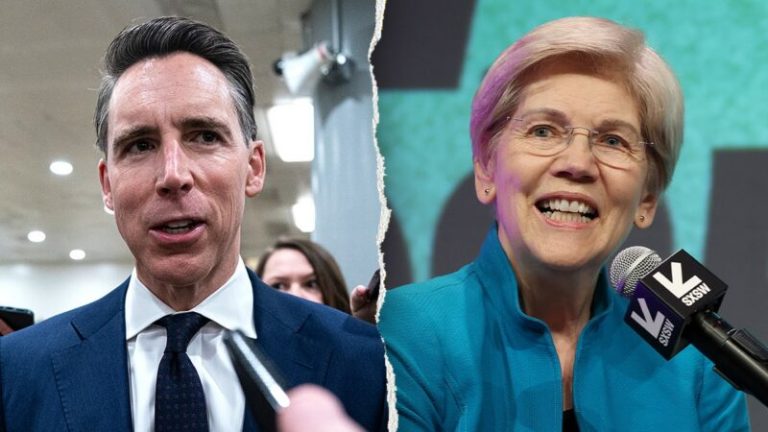
FIRST ON FOX: An unlikely bipartisan duo is teaming up to force defense contractors to prioritize military readiness over shareholder value.

Sens. Josh Hawley, R-Mo., and Elizabeth Warren, D-Mass., introduced legislation that would require major defense contractors to prioritize delivering weapons by fulfilling their contracts fueled by taxpayer dollars over rewarding shareholders, with stiffer guardrails and oversight on the companies.

Their bill, Prioritizing the Warfighter in Defense Contracting Act of 2026, would restrict stock buybacks, dividends and high executive pay unless companies meet Pentagon performance standards in their contracts.

TRUMP OVERHAULS US ARMS SALES TO FAVOR KEY ALLIES, PROTECT AMERICAN WEAPONS PRODUCTION

“America’s defense contractors should be focused on expanding production, not padding their bottom lines,” Hawley said in a statement to Fox News Digital. “But even as they make record profits, some firms have spent big on stock buybacks, dividend payouts and exorbitant executive salaries.”

The lawmakers argued that for several years, defense contractors have struggled to deliver weapons systems on time, on budget or in sufficient quantities for the military, and instead dumped the eye-popping sums of taxpayer money flowing to them into their own coffers, rather than invest in research and development that could speed up the process.

They pointed to a Government Accountability Office (GAO) report published last year that found that defense acquisition programs were plagued by delays and cost overruns, with delays for major programs increasing “by 18 months” in just the last year, with combined cost estimates creeping over $49 billion during the same period.

TRUMP-BACKED AFFORDABLE HOUSING OVERHAUL CLEARS SENATE, WHILE HOUSE GOP RAISES RED FLAGS

Since 2021, the top four defense contractors — Lockheed Martin, Raytheon, General Dynamics and Boeing — have increased spending and spent $89 billion on stock buybacks and dividends. Two-thirds of that came from taxpayer dollars, according to Warren’s office.

“It makes no sense for the federal government to fork over billions in taxpayer dollars to giant military contractors while their executives buy back their own company’s stock instead of investing in our national defense,” Warren said in a statement to Fox News Digital. “This bipartisan bill will stop defense contractors from abusing the system at taxpayer expense and put our national security over Wall Street profits.”

The legislation also gives the Pentagon more oversight tools to identify underperforming defense contractors and require those contractors to submit a remediation plan.

GOP SENATOR PUSHES TRUMP’S 10% CREDIT CARD RATE CAP AS PARTY LEADERS PUSH BACK

It also grants the Department of War stronger enforcement powers for contractors that aren’t meeting the agency’s standards, including suspending contract payments, ending eligibility for progress payments or terminating contracts altogether.

Hawley and Warren’s bill would also require the Pentagon to provide public reports on the contractors subject to their law, which contractors were granted waivers from the change in requirements and which companies have violated the rules.

The legislation would also codify an executive order President Donald Trump signed earlier this year that required a similar crackdown on underperforming defense contractors.

“Earlier this year, President Trump led the way with an executive order barring underperforming defense companies from engaging in these practices,” Hawley said. “Now, it’s time for Congress to act by codifying the President’s executive order into law, ensuring that America’s warfighters are prioritized over corporate profit.”

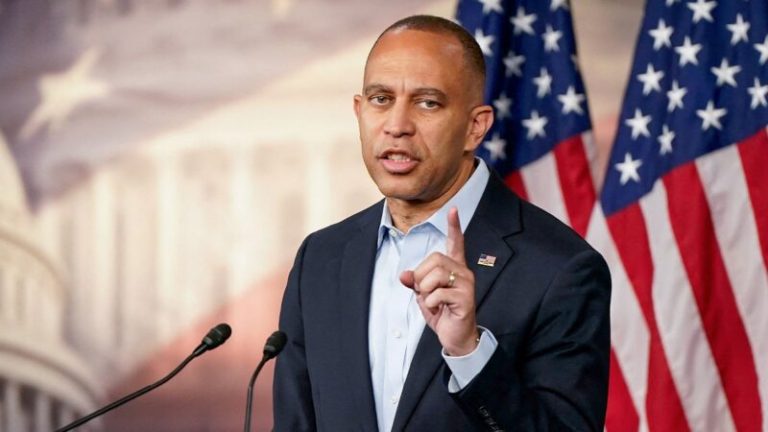
House Minority Leader Hakeem Jeffries, D-N.Y., once said that failing to fully fund the Department of Homeland Security (DHS) was “legislative malpractice” — a position he is now rejecting in the current funding standoff with Republicans.

“We are here today to do a single job, and that should be to fund fully the Department of Homeland Security,” Jeffries said during a 2015 speech on the House floor. 

Jeffries, near the start of his congressional career, urged the Republican-controlled House to pass a “clean” DHS bill that year when the department was on the brink of a partial government shutdown.

“Anything else is an abdication of our responsibility. Anything else is an act of legislative malpractice,” Jeffries said at the time, referring to providing full-year appropriations to the department.

REPORTER’S NOTEBOOK: GOP EYES DHS DEAL FUNDING ICE PROBES, BUT NOT REMOVALS, AS SHUTDOWN DRAGS

A decade later, Jeffries has reversed that position, arguing that fully funding DHS would be a failure of Congress. He and Senate Minority Leader Chuck Schumer, D-N.Y., have withheld their votes on a full-year DHS funding bill as they demand various reforms to rein in immigration enforcement.

“Taxpayer dollars should be used to make life more affordable for the American people, not brutalize or kill them,” Jeffries said in February. “The American people know ICE [Immigration and Customs Enforcement] is out of control.”

The 39-day funding standoff has snarled air travel across the country as passengers face hours-long wait times at airport security checkpoints due to a shortage of TSA workers. Tens of thousands of DHS employees — including TSA agents — are reporting to work without pay during the shutdown, leading some to call off work or quit altogether.

Some TSA personnel are sleeping in cars and selling blood plasma to make ends meet, Acting Deputy TSA Administrator Adam Stahl said Tuesday.

Jeffries is expected to vote against a full-year DHS measure with a majority of House Democrats this week. The minority leader has repeatedly voted against a “clean” DHS spending measure since the funding lapse began on Feb. 14.

EXCLUSIVE: HOUSE REPUBLICANS TO HOLD HEARING ON DHS SHUTDOWN RISKS AMID TRAVEL SURGE

House Speaker Mike Johnson, R-La., has narrowly steered the legislation through his chamber with largely Republican votes, but the spending measure has stalled in the Senate with nearly all Democrats moving to filibuster it. 

Jeffries, by contrast, is seeking to force a vote on a DHS appropriations bill that would fund the department minus its immigration enforcement functions. 

“We can fund TSA, fund the Coast Guard, fund FEMA, fund our cybersecurity professionals or continue to allow ICE to brutalize and, in some cases, kill American citizens or to violently target law-abiding immigrant families,” Jeffries said during a news conference last week.

It’s a position that he warned could put Americans in danger during the 2015 speech.

“We’re playing political games at a time when the safety and the security of the American people is being threatened,” Jeffries said regarding the prospect of not passing a full-year DHS bill.

A spokesperson for Jeffries did not immediately respond to Fox News Digital’s request for comment.

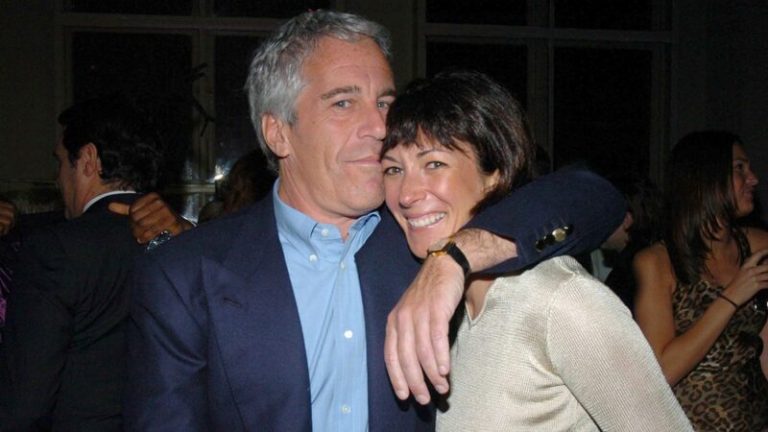
A former accountant and lawyer for the disgraced financier Jeffrey Epstein both told the House Oversight Committee earlier this month that the Department of Justice had never interviewed them about Epstein’s crimes.

“I’ve never been questioned by any government authority,” Epstein’s ex-accountant Richard Kahn said.

He noted that he had received a grand jury subpoena from the Southern District of New York and from the U.S. Virgin Island’s Department of Justice for documents about Epstein’s property.

“Both of the requests were for the same thing. They were asking for Epstein’s estate documents. They wanted to see his will and his 1953 trust,” Kahn said.

HOUSE OVERSIGHT SUBPOENAS AG BONDI IN PROBE OF EPSTEIN CASE ‘MISMANAGEMENT’

Similarly, Darren Indyke said he had never been asked about Epstein’s dealings.

“Personally, no,” Indyke told the Oversight Committee. “I don’t believe I have.”

When asked if that surprised him, Indyke told investigators he believed it was consistent with the scope of his employment.

“Given my role as a transactional attorney for Mr. Epstein, no,” Indyke said.

Epstein, a former financier with a formidable social circle, died in 2019 while imprisoned on charges of sex trafficking minors. His death, which was ruled a suicide, left behind questions about whether Epstein had facilitated illegal sexual encounters for some of his contacts and prompted public demands for accountability for possible accomplices.

Like many public figures, Kahn and Indyke both appear in the Epstein Files — troves of documents released by the DOJ in compliance with the Epstein Files Transparency Act.

HOUSE OVERSIGHT COMMITTEE CALLS BILL GATES, LEON BLACK TO TESTIFY OVER JEFFREY EPSTEIN TIES

Their communications in the files do not, on their own, implicate any wrongdoing, and neither does their appearance before the House Oversight Committee.

Their depositions come among a series of other interviews from lawmakers on Capitol Hill. Interviewers have called figures like former President Bill Clinton, former Secretary of State Hillary Clinton, billionaire businessman Les Wexner and Epstein’s accomplice and romantic partner Ghislaine Maxwell to deliver testimony.

So far, none of the subjects interviewed by the Oversight Committee has faced charges for their proximity to Epstein, except for Maxwell. She was convicted in 2022 on charges of exploiting underage girls.

Indyke, the attorney, said he was aware of Epstein’s original 2008 plea deal in Florida, where he admitted to soliciting a minor for prostitution.

“He was adamant that he had no idea that anyone involved was underage and personally assured me that he would never again let himself be in that position. I believed him, and I made the mistake of believing that Mr. Epstein would not again commit a crime,” Indyke said.

GHISLAINE MAXWELL PLEADS FIFTH AMENDMENT, DODGES QUESTIONS IN HOUSE OVERSIGHT EPSTEIN PROBE

Kahn, Epstein’s accountant, gave a similar statement.

“Epstein told me his 2006 arrest was a mistake, that he did not know the woman was underage, and that nothing like that would happen again,” Kahn said.

“I believed him at the time and never saw what appeared to be a minor in his presence. Had I learned of his horrific behavior, I would have quit work immediately,” Kahn added.

Fox News Digital reached out to Kahn and Indyke for comment.

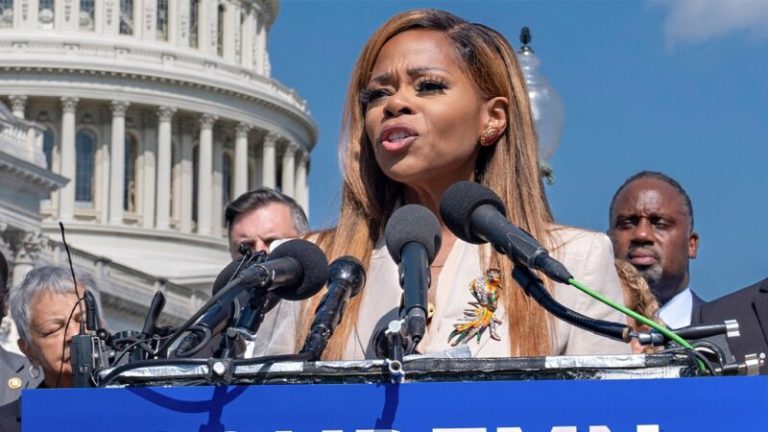
An embattled lawmaker facing five decades in prison will face the congressional spotlight Thursday during an ethics trial that could result in her expulsion from the House of Representatives.

Rep. Sheila Cherfilus-McCormick, D-Fla., is expected to testify before the House Ethics Committee during a rare public hearing Thursday afternoon. The case is separate from a sprawling federal indictment accusing Cherfilus-McCormick of stealing more than $5 million in disaster relief funds to finance her inaugural congressional run in 2021 and purchase luxury items, including a large diamond ring. The Florida Democrat is also alleged to have participated in a straw donor scheme and conspired to file a false federal tax return.

Cherfilus-McCormick has repeatedly sought to delay the hearing, citing the ongoing federal criminal case and losing her legal representation earlier in March. It is not clear whether the Florida Democrat will be represented by an attorney at the hearing. 

Cherfilus McCormick said in a statement sent to Fox News that she is “deeply disappointed” the bipartisan committee chose to proceed with a trial, alleging a violation of her due process rights.

NANCY MACE TO FORCE VOTE TARGETING FELLOW GOP LAWMAKER ACCUSED OF AFFAIR WITH STAFFER

“I urge the Committee to follow its own precedents and uphold fairness and not allow this process to be driven by politics or numbers,” Cherfilus-McCormick said. “I welcome the opportunity to set the record straight and challenge these inaccuracies, when I am legally able to do so.”

Cherfilus-McCormick has denied wrongdoing after being indicted in November 2025 and pleaded not guilty in federal court. She has repeatedly defied calls from Republicans to resign — a move that would have avoided the ethics hearing and possible expulsion.

According to the indictment, Trinity Health Care Services, a company owned by Cherfilus-McCormick and her brother, Edwin Cherfilus, received $5 million in Federal Emergency Management Agency (FEMA) overpayment from the state of Florida for a COVID-19 vaccine contract.

Rather than return the money, federal prosecutors allege the duo laundered the money through multiple bank accounts to hide its origin.

The House Ethics Committee unveiled a 27-count “statement of alleged violations” against Cherfilus-McCormick that is expected to be presented during the hearing Thursday. 

The hearing itself is extremely rare. It will be the first time the eight-member panel will hold a public hearing against a lawmaker since 2010.

MIKE JOHNSON ASKS EMBATTLED HOUSE REPUBLICAN TONY GONZALES TO DROP RE-ELECTION BID

Rep. Greg Steube, R-Fla., has said he would move forward with a resolution seeking to expel Cherfilus-McCormick regardless of the trial’s outcome. Under House rules, two-thirds of lawmakers — meaning a swath of Democrats — would need to vote in the affirmative to expel the Florida Democrat. 

“You’re in a situation where you have a sitting member of Congress who’s allegedly stolen over $5 million in taxpayer funds,” Steube told reporters Tuesday. “She should immediately resign instead of going through this process. But she’s going to force us to do this.”

Steube also said a possible recommendation of expulsion from the committee could force Democrats to support his resolution.

“If the committee in a bipartisan manner, it recommends an expulsion that puts the Democratic caucus in a very tough position because you would be undermining your own members on the Ethics Committee.”

But House Democratic leadership, who have largely defended Cherfilus-McCormick, has yet to say whether they would support an expulsion resolution following the hearing’s conclusion. 

Cherfilus-McCormick was among a group of Democrats who stood behind House Minority Leader Hakeem Jeffries, D-N.Y., when he gave remarks on the Department of Homeland Security (DHS) shutdown outside the U.S. Capitol last week. He responded, “next question,” when asked by Fox News about the expulsion threat on Tuesday.

“I’m not going to prejudge the outcome that they arrive to,” House Democratic Conference Chairman Pete Aguilar, D-Calif., said Wednesday. “I respect the members of the ethics committee and the work that they have to do.”

Democrats’ refusal so far to condemn Cherfilus-McCormick has prompted sharp criticism from Republicans. 

“So-called ‘Leader’ Hakeem Jeffries talks a big game on corruption, but when it’s one of his own, he suddenly loses his voice,” NRCC spokesman Mike Marinella said in a statement. 

Some Republicans have also complained about a double standard with the chamber’s treatment of Cherfilus-McCormick by making comparisons to former Rep. George Santos, R-N.Y. The scandal-plagued lawmaker was expelled from Congress in 2023 before an ethics hearing or criminal conviction.

“It seems like what happened to George was just like a runaway freight train up here,” Rep. Byron Donalds, R-Fla., said Wednesday. “They didn’t even give George an opportunity to get fully through ethics. And so this one’s been a little bit more deliberate.”

“I think going forward, how this one’s been conducted is how it should go,” Donalds added, referring to the anticipated Cherfilus-McCormick hearing. “It should be deliberate before these kind of judgments just end up on the House floor.”

The clock that was ticking toward a dramatic new escalation in the Iran war may now be counting down to a deal that would end it.

That’s the latest stunning turn of events delivered by President Donald Trump’s social media account.

Trump announced Monday that he was postponing his threatened military strikes against Iranian power plants for at least five days, hours ahead of his deadline for Tehran to reopen the crucial Strait of Hormuz shipping route.

He said the U.S. and Iran were in “productive” talks toward a “complete and total” resolution of the war, though Tehran denied any direct talks.

Follow live updates

Now in its fourth week, the conflict has consumed the Middle East, pushed up the prices of energy and food and threatened the global economy with a far-reaching crisis.

Trump’s reversal delays what many feared would be a significant new escalation for civilians across the region.

Iran’s Foreign Affairs Ministry appeared to counter Trump’s version of events, though, saying in a statement published by the semiofficial news agency Mehr News that there was “no dialogue between Tehran and Washington.”

It said Trump’s delay was “part of efforts to reduce energy prices and buy time to implement his military plans” but acknowledged “there are initiatives from regional countries to reduce tensions.” Iranian state media said Trump had “backed down” after Iran vowed swift retaliation for any attacks on its energy infrastructure.

This article is part of “Unaffordable America,” a series examining rising economic inequality in the U.S. and the policies that drive it.

How’s the economy?

Not bad if you’re rich.

Demand for luxury yachts and private jets is surging thanks to last year’s tax law. Sales of $10 million-plus mansions are booming as stocks hit new highs. And the wealthy and powerful will get to enjoy a new ballroom for galas at the White House.

What if you aren’t rich?

The typical American can’t afford the median-priced home. A new car is out of reach for many, with the average monthly payment exceeding $700. Food banks are seeing a growing number of people skipping meals because they can’t afford groceries, and more middle-class Americans are selling their plasma to make ends meet.

The divide between rich and poor in America is the widest it’s been in at least a generation — and growing. The amount of wealth held by the top 1% increased at more than double the rate of the bottom 90% in the first nine months of last year, according to Federal Reserve figures. At the very top, Elon Musk’s fortune is approaching that of legendary 19th-century businessman John D. Rockefeller when looked at as a share of the overall U.S. economy.

A variety of factors have shaped the struggles of everyday Americans and fueled the gains of the wealthy: The pandemic disrupted the housing market, making it harder to afford a home. Stocks have surged, driven by enthusiasm over AI. Manufacturing has waned, hiring has slipped and costs continue to rise.

President Donald Trump’s policies are amplifying these trends. One year into his second term, his administration has cut programs helping lower-income households while advancing policies benefiting the wealthy and corporations. He’s signed legislation to cut food stamps and Medicaid benefits and put new restrictions on low-income housing assistance and student loans. To cope with higher costs from tariffs, he has suggested Americans buy fewer dolls for their children.

Meanwhile, the Trump administration has given billions of dollars in tax cuts to corporations and the wealthy and loosened regulations on banks while easing rules around cryptocurrency, which he’s benefited from personally.

“Donald Trump talks a lot about the working class, his MAGA base is primarily working class, but if you look at the data, the working class is doing very badly in the second Trump administration,” said Robert Reich, a professor emeritus at the University of California, Berkeley, who led the Labor Department during the Clinton administration. “The real growth in the second Trump administration has been in corporate profits and in the wealth of the people at the top.”

Trump has defended his economic record, referring to concerns over affordability as a hoax and blaming weakness in the economy on Democrats. He’s dismissed numerous polls showing increasing economic anxiety, saying in his State of the Union address in February that he has ushered in a “golden age of America.” As evidence, he cited rising 401(k) balances, a drop in mortgage rates and lower gas prices — though gas prices have since spiked after his attacks on Iran disrupted the global flow of oil. The S&P 500, fueled by an AI boom, grew around 13% during the first year of his second term.

Trump’s allies argue that, while it may take time, all Americans will benefit from last summer’s tax cuts, with the average refund rising by around $1,000 this year, according to data cited by the White House. They also say that Trump’s still-evolving tariffs will eventually boost U.S. manufacturing jobs, which declined last year, noting announcements by foreign governments and corporations about plans to invest in the U.S.

A White House official also pointed to signs of improvement, including a lower rate of inflation than in the past several years and wages that are rising faster than inflation.

Some economists, including those who have served in past Republican administrations, have questioned whether those improvements will be enough to offset pressures elsewhere in the economy, including from a slowing job market, which shed 92,000 jobs in February across a broad range of industries.

For “Unaffordable America,” a yearlong series on the causes and effects of rising economic inequality, NBC News asked readers how they were faring and heard from hundreds of people. In interviews and written responses, many described struggling to find a job and afford higher food prices and health care costs, while others said they were benefiting from gains in the stock market and lower interest rates.

The Defense Department will remove media offices from the Pentagon after a federal judge sided with The New York Times in a lawsuit challenging limits on reporters’ access to the building, a department official announced Monday.

An area of the Pentagon known as “Correspondents’ Corridor” that reporters have used for decades to cover the U.S. military will close immediately, department spokesperson Sean Parnell said. Journalists will eventually be able to work from an “annex” outside the building, which he said “will be available when ready.” He offered no detail about how long that will take.

The Pentagon Press Association said the announcement “is a clear violation of the letter and spirit of last week’s ruling.”

“At such a critical time, we ask why the Pentagon is choosing to restrict vital press freedoms that help inform all Americans,” the association said.

The new policy is the latest dispute over press access to President Donald Trump’s administration, which has limited legacy media while boosting conservative and pro-Trump outlets.

The Times sued the Pentagon and Defense Secretary Pete Hegseth in December, claiming the agency’s new credentialing policy violated journalists’ constitutional rights to free speech and due process. Dozens of reporters had walked out of the building rather than agree to government-imposed restrictions on their work.

U.S. District Judge Paul Friedman in Washington, D.C., last week sided with the newspaper. He ordered the Pentagon to reinstate the press credentials of seven Times journalists and struck down some of the agency’s restrictions on news reporting.

Friedman said the “undisputed evidence” shows that the policy is designed to weed out “disfavored journalists” and replace them with those who are “on board and willing to serve” the government, a clear instance of illegal viewpoint discrimination.

Parnell said the Defense Department disagrees with the ruling and is pursuing an appeal. He said security concerns prompted restrictions on press access, a claim that journalists have rejected.

Under the latest Pentagon rules announced Monday, journalists will still have access to the Pentagon for press conferences and interviews arranged through the department’s public affairs team, but they will have to be escorted, Parnell wrote on social media.

The current Pentagon press corps is comprised mostly of conservative outlets that agreed to the policy. Reporters from outlets that refused to consent to the new rules, including from The Associated Press, have continued reporting on the military.

The AP, meanwhile, is awaiting a decision by a three-judge panel of the U.S. District Court of Appeals on its separate lawsuit against President Donald Trump’s administration. The AP contends that Trump’s White House team punished it by reducing its access to presidential events because the outlet hasn’t followed his lead in renaming the Gulf of Mexico.

U.S. stocks surged Monday, after President Donald Trump announced that he was postponing all military strikes on Iranian power plants for a five-day period.

Trump said the U.S. and Iran had engaged in what he called “very good and productive conversations regarding a complete and total resolution of our hostilities in the Middle East.”

Reporting about the nature and timing of these “conversations” evolved over the course of the day, and included conflicting accounts from various stakeholders.

But for markets, the talks offered a glimmer of hope that a path toward the de-escalation of the conflict — and the oil crisis it created — were within reach.

Iranian state media responded to Trump’s post by saying the U.S. president has “backed down” after Iran’s firm response.

Trump, however, said that Iran had “called” to discuss trying to resolve the war diplomatically.

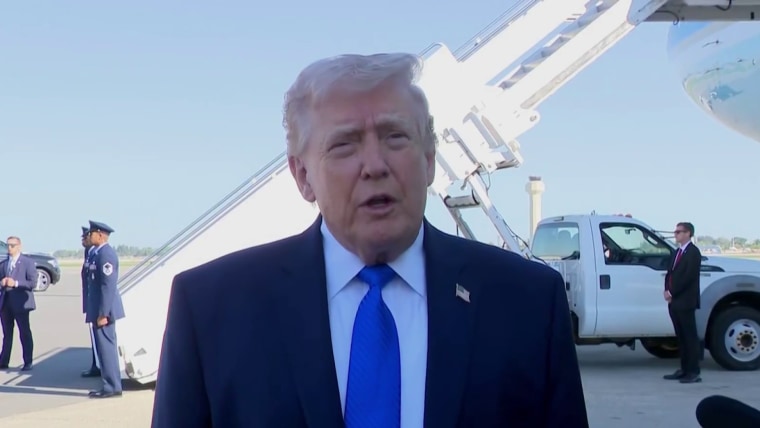
“They want to make a deal, and we are very willing to make it,” Trump told reporters before boarding Air Force One in Florida.

The Strait of Hormuz, a crucial transit point for global oil supplies, could be “open very soon,” Trump added, but he provided few details.

Experts and analysts quickly pointed out that even if the fighting were to end this week, it would still take months for the strait to reopen.

The S&P 500 and Nasdaq 100 futures initially soared about 3% on Trump’s post shortly after 7 a.m. ET. By the time the closing bell rang, both indexes still recorded significant gains, but less than futures had indicated early in the morning. The S&P 500 closed up 1.1% and the Nasdaq Composite ended the day higher by 1.4%.

The gains were also broad based, with every S&P sector ending the day higher.

The Dow Jones Industrial Average also shot higher immediately after Trump’s statement. By the end of the trading session, the Dow was higher by 631 points, and the Russell 2000 index closed up 2.7%.

It was the best day for the S&P, Nasdaq and Dow since Feb. 6.

Oil prices plunged around 11% and U.S. crude oil settled for the day at $88.13 per barrel. International Brent crude oil fell to $99.94 per barrel, settling under $100 per barrel for the first time since March 11.

Still, crude oil prices have risen more than 30% since the war began on Feb. 28, and more than 50% since the start of the year.

Trump’s Monday announcement on social media came after the president on Saturday said that he had given the Iranian regime 48 hours to “fully open, without threat, the Strait of Hormuz.” That ultimatum was set to expire Monday night.

U.S. natural gas prices dropped 6% Monday, European natural gas futures slid 9% and heating oil prices dropped 12%. Heating oil futures can also be a proxy for the price of jet fuel.

U.S. Treasury bonds also rose in the minutes after Trump’s comments, and the yields which guide borrowing rates for consumers dropped after posting big moves higher on Thursday and Friday on rising inflation fears stemming from soaring energy prices. Yields were down only slightly in mid-morning trading after the statements from Iranian media and Trump.

Investors were already grappling with how to trade headlines about the war before Monday’s volatility.

“Investors have two related problems in pricing risks around the Gulf war,” UBS economist Paul Donovan said in a note on Monday before Trump’s post. “Statements from top U.S. administration officials give different and at times contradictory assessments of the war; in the absence of measurable objectives, this is all markets have to respond to. The result is volatility.”

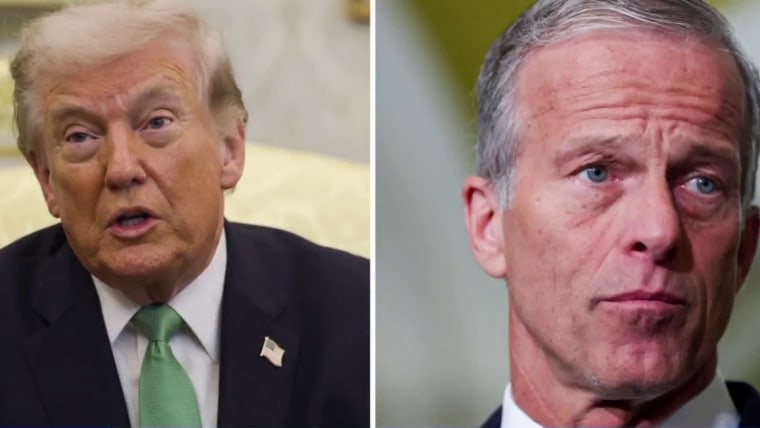
WASHINGTON — On Sunday, Senate Majority Leader John Thune, R-S.D., discussed an off-ramp with President Donald Trump to reopen TSA and end the long lines and delays at airports.

It would fund all of the Department of Homeland Security except for ICE, which Democrats have refused to support without new limitations on immigration enforcement operations, two sources with knowledge of the conversation told NBC News.

White House aides initially conveyed the idea to Trump and, after that briefing, Thune spoke with the president, the two sources said. Thune discussed the idea with Republicans on Capitol Hill, one of the sources said. The second source said it’s seen by numerous Republicans as a viable path to break the logjam.

ICE would be funded separately by Republicans in a party-line “reconciliation” bill that can pass without the need for any Democratic support later in the year.

The Department of Homeland Security has been shut down for more than a month, and while key operations, such as TSA and the Federal Emergency Management Agency, are still operating, many of those employees are working without pay. As NBC News reported this weekend, more than 400 TSA officers have quit since the shutdown began. Immigration and Customs Enforcement is also shut down, but its employees are being paid through Trump’s big beautiful bill passed last year.

Republicans believe that the off-ramp Trump and Thune discussed would win support from Democrats, who have offered to fund noncontroversial parts of the Department of Homeland Security on the Senate floor while the two parties continue to negotiate on immigration.

But Trump rejected it — as he made clear in a Truth Social post Sunday night.

“I don’t think we should make any deal with the Crazy, Country Destroying, Radical Left Democrats unless, and until, they Vote with Republicans to pass ‘THE SAVE AMERICA ACT,’” Trump wrote, while instead calling on Republicans to “Kill the Filibuster, and stay in D.C. for Easter, if necessary.”

Trump’s first two ideas aren’t viable. Democrats are determined to sink the SAVE America Act, which doesn’t have enough support to pass. And Republicans have made clear they lack the votes to nuke the filibuster. They may, however, cancel recess if there’s still no deal by the end of this week.

The conversation with Thune and Trump was first reported by Punchbowl News.

Speaking Monday in Memphis, Tennessee, the president doubled down on his demands to pair Homeland Security funding with the voting bill.

“You don’t have to take a fast vote. Don’t worry about Easter, going home. In fact, make this one for Jesus. OK, make this one for Jesus,” Trump said, adding: “The most important part of homeland security is voter ID and proof of citizenship. Nobody can vote on Homeland Security without voter ID or proof of citizenship.”

Senate Minority Leader Chuck Schumer’s office said that Democrats will again seek unanimous consent to fund just the TSA on the Senate floor Monday, for the eighth time.

Republicans have so far rejected those stand-alone bills.

If Trump were to change his mind and accept the Thune-GOP idea, it carries benefits for both parties. For Republicans, they could avoid giving into Democratic demands, such as requiring immigration enforcement officers to remove their masks and requiring judicial warrants to conduct raids. For Democrats, they could keep their fingerprints off ICE funding, which has become toxic with their base since Homeland Security agents killed protesters Alex Pretti and Renee Good in Minneapolis.

“We can be out of this shutdown by the end of the week,” Sen. John Kennedy, R-La., said Sunday. “Here’s what we do. The Democrats are amenable to opening up everything at DHS but ICE. We should accept that. The very next day, we should file a budget resolution through reconciliation that funds ICE as we deem appropriate. We don’t need Democratic votes to do that.”

Democrats are also planning to seize on the Trump social media post to argue that he owns the shutdown and travel chaos.

Reconciliation bills are arduous, requiring near-unanimous support among Republicans, especially given the tiny House majority. There has been deep skepticism that the party could pull it off, even if it tried. But needing to fund an agency like ICE would raise the impetus to use that path.

Under the “big, beautiful bill” passed by Republicans last year, ICE received a cash infusion of about $75 billion for the next four years to help carry out Trump’s mass deportation program.

The path comes with another possible upside for the White House: Some Trump allies have proposed reconciliation to approve supplemental funding for Trump’s war in Iran. It’s not clear that could win enough Democratic support.