Archive

March 2026

Browsing

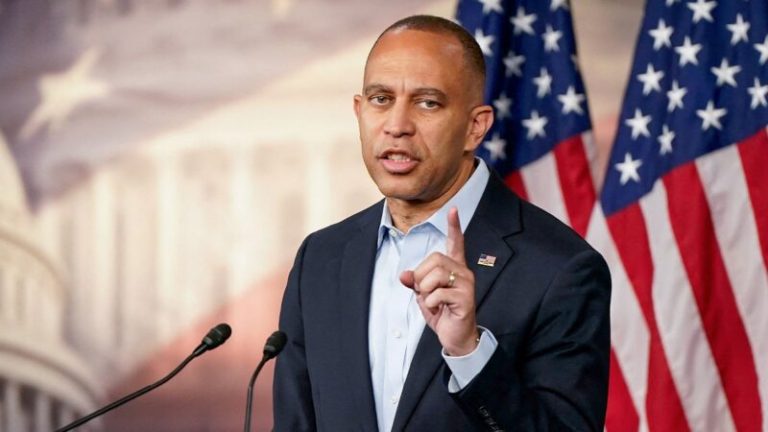
House Minority Leader Hakeem Jeffries, D-N.Y., once said that failing to fully fund the Department of Homeland Security (DHS) was “legislative malpractice” — a position he is now rejecting in the current funding standoff with Republicans.

“We are here today to do a single job, and that should be to fund fully the Department of Homeland Security,” Jeffries said during a 2015 speech on the House floor. 

Jeffries, near the start of his congressional career, urged the Republican-controlled House to pass a “clean” DHS bill that year when the department was on the brink of a partial government shutdown.

“Anything else is an abdication of our responsibility. Anything else is an act of legislative malpractice,” Jeffries said at the time, referring to providing full-year appropriations to the department.

REPORTER’S NOTEBOOK: GOP EYES DHS DEAL FUNDING ICE PROBES, BUT NOT REMOVALS, AS SHUTDOWN DRAGS

A decade later, Jeffries has reversed that position, arguing that fully funding DHS would be a failure of Congress. He and Senate Minority Leader Chuck Schumer, D-N.Y., have withheld their votes on a full-year DHS funding bill as they demand various reforms to rein in immigration enforcement.

“Taxpayer dollars should be used to make life more affordable for the American people, not brutalize or kill them,” Jeffries said in February. “The American people know ICE [Immigration and Customs Enforcement] is out of control.”

The 39-day funding standoff has snarled air travel across the country as passengers face hours-long wait times at airport security checkpoints due to a shortage of TSA workers. Tens of thousands of DHS employees — including TSA agents — are reporting to work without pay during the shutdown, leading some to call off work or quit altogether.

Some TSA personnel are sleeping in cars and selling blood plasma to make ends meet, Acting Deputy TSA Administrator Adam Stahl said Tuesday.

Jeffries is expected to vote against a full-year DHS measure with a majority of House Democrats this week. The minority leader has repeatedly voted against a “clean” DHS spending measure since the funding lapse began on Feb. 14.

EXCLUSIVE: HOUSE REPUBLICANS TO HOLD HEARING ON DHS SHUTDOWN RISKS AMID TRAVEL SURGE

House Speaker Mike Johnson, R-La., has narrowly steered the legislation through his chamber with largely Republican votes, but the spending measure has stalled in the Senate with nearly all Democrats moving to filibuster it. 

Jeffries, by contrast, is seeking to force a vote on a DHS appropriations bill that would fund the department minus its immigration enforcement functions. 

“We can fund TSA, fund the Coast Guard, fund FEMA, fund our cybersecurity professionals or continue to allow ICE to brutalize and, in some cases, kill American citizens or to violently target law-abiding immigrant families,” Jeffries said during a news conference last week.

It’s a position that he warned could put Americans in danger during the 2015 speech.

“We’re playing political games at a time when the safety and the security of the American people is being threatened,” Jeffries said regarding the prospect of not passing a full-year DHS bill.

A spokesperson for Jeffries did not immediately respond to Fox News Digital’s request for comment.

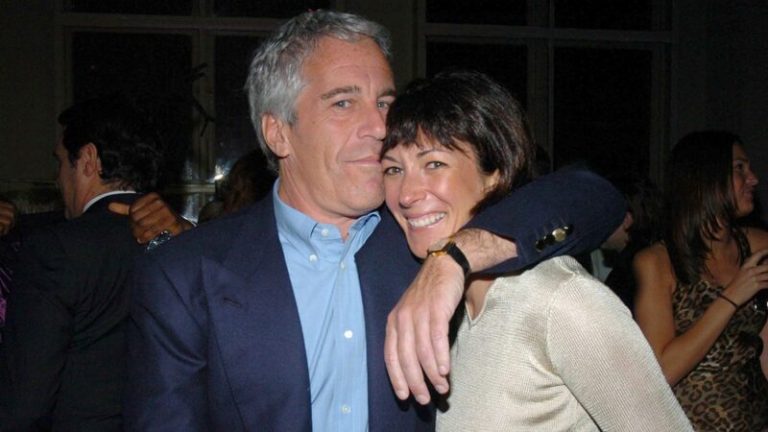
A former accountant and lawyer for the disgraced financier Jeffrey Epstein both told the House Oversight Committee earlier this month that the Department of Justice had never interviewed them about Epstein’s crimes.

“I’ve never been questioned by any government authority,” Epstein’s ex-accountant Richard Kahn said.

He noted that he had received a grand jury subpoena from the Southern District of New York and from the U.S. Virgin Island’s Department of Justice for documents about Epstein’s property.

“Both of the requests were for the same thing. They were asking for Epstein’s estate documents. They wanted to see his will and his 1953 trust,” Kahn said.

HOUSE OVERSIGHT SUBPOENAS AG BONDI IN PROBE OF EPSTEIN CASE ‘MISMANAGEMENT’

Similarly, Darren Indyke said he had never been asked about Epstein’s dealings.

“Personally, no,” Indyke told the Oversight Committee. “I don’t believe I have.”

When asked if that surprised him, Indyke told investigators he believed it was consistent with the scope of his employment.

“Given my role as a transactional attorney for Mr. Epstein, no,” Indyke said.

Epstein, a former financier with a formidable social circle, died in 2019 while imprisoned on charges of sex trafficking minors. His death, which was ruled a suicide, left behind questions about whether Epstein had facilitated illegal sexual encounters for some of his contacts and prompted public demands for accountability for possible accomplices.

Like many public figures, Kahn and Indyke both appear in the Epstein Files — troves of documents released by the DOJ in compliance with the Epstein Files Transparency Act.

HOUSE OVERSIGHT COMMITTEE CALLS BILL GATES, LEON BLACK TO TESTIFY OVER JEFFREY EPSTEIN TIES

Their communications in the files do not, on their own, implicate any wrongdoing, and neither does their appearance before the House Oversight Committee.

Their depositions come among a series of other interviews from lawmakers on Capitol Hill. Interviewers have called figures like former President Bill Clinton, former Secretary of State Hillary Clinton, billionaire businessman Les Wexner and Epstein’s accomplice and romantic partner Ghislaine Maxwell to deliver testimony.

So far, none of the subjects interviewed by the Oversight Committee has faced charges for their proximity to Epstein, except for Maxwell. She was convicted in 2022 on charges of exploiting underage girls.

Indyke, the attorney, said he was aware of Epstein’s original 2008 plea deal in Florida, where he admitted to soliciting a minor for prostitution.

“He was adamant that he had no idea that anyone involved was underage and personally assured me that he would never again let himself be in that position. I believed him, and I made the mistake of believing that Mr. Epstein would not again commit a crime,” Indyke said.

GHISLAINE MAXWELL PLEADS FIFTH AMENDMENT, DODGES QUESTIONS IN HOUSE OVERSIGHT EPSTEIN PROBE

Kahn, Epstein’s accountant, gave a similar statement.

“Epstein told me his 2006 arrest was a mistake, that he did not know the woman was underage, and that nothing like that would happen again,” Kahn said.

“I believed him at the time and never saw what appeared to be a minor in his presence. Had I learned of his horrific behavior, I would have quit work immediately,” Kahn added.

Fox News Digital reached out to Kahn and Indyke for comment.

An embattled lawmaker facing five decades in prison will face the congressional spotlight Thursday during an ethics trial that could result in her expulsion from the House of Representatives.

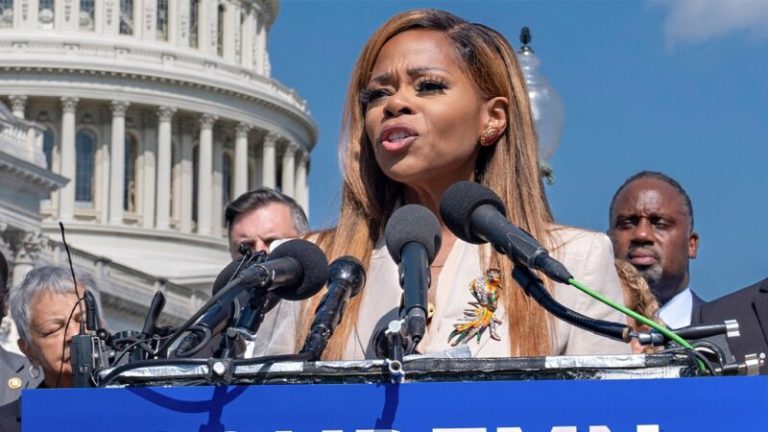
Rep. Sheila Cherfilus-McCormick, D-Fla., is expected to testify before the House Ethics Committee during a rare public hearing Thursday afternoon. The case is separate from a sprawling federal indictment accusing Cherfilus-McCormick of stealing more than $5 million in disaster relief funds to finance her inaugural congressional run in 2021 and purchase luxury items, including a large diamond ring. The Florida Democrat is also alleged to have participated in a straw donor scheme and conspired to file a false federal tax return.

Cherfilus-McCormick has repeatedly sought to delay the hearing, citing the ongoing federal criminal case and losing her legal representation earlier in March. It is not clear whether the Florida Democrat will be represented by an attorney at the hearing. 

Cherfilus McCormick said in a statement sent to Fox News that she is “deeply disappointed” the bipartisan committee chose to proceed with a trial, alleging a violation of her due process rights.

NANCY MACE TO FORCE VOTE TARGETING FELLOW GOP LAWMAKER ACCUSED OF AFFAIR WITH STAFFER

“I urge the Committee to follow its own precedents and uphold fairness and not allow this process to be driven by politics or numbers,” Cherfilus-McCormick said. “I welcome the opportunity to set the record straight and challenge these inaccuracies, when I am legally able to do so.”

Cherfilus-McCormick has denied wrongdoing after being indicted in November 2025 and pleaded not guilty in federal court. She has repeatedly defied calls from Republicans to resign — a move that would have avoided the ethics hearing and possible expulsion.

According to the indictment, Trinity Health Care Services, a company owned by Cherfilus-McCormick and her brother, Edwin Cherfilus, received $5 million in Federal Emergency Management Agency (FEMA) overpayment from the state of Florida for a COVID-19 vaccine contract.

Rather than return the money, federal prosecutors allege the duo laundered the money through multiple bank accounts to hide its origin.

The House Ethics Committee unveiled a 27-count “statement of alleged violations” against Cherfilus-McCormick that is expected to be presented during the hearing Thursday. 

The hearing itself is extremely rare. It will be the first time the eight-member panel will hold a public hearing against a lawmaker since 2010.

MIKE JOHNSON ASKS EMBATTLED HOUSE REPUBLICAN TONY GONZALES TO DROP RE-ELECTION BID

Rep. Greg Steube, R-Fla., has said he would move forward with a resolution seeking to expel Cherfilus-McCormick regardless of the trial’s outcome. Under House rules, two-thirds of lawmakers — meaning a swath of Democrats — would need to vote in the affirmative to expel the Florida Democrat. 

“You’re in a situation where you have a sitting member of Congress who’s allegedly stolen over $5 million in taxpayer funds,” Steube told reporters Tuesday. “She should immediately resign instead of going through this process. But she’s going to force us to do this.”

Steube also said a possible recommendation of expulsion from the committee could force Democrats to support his resolution.

“If the committee in a bipartisan manner, it recommends an expulsion that puts the Democratic caucus in a very tough position because you would be undermining your own members on the Ethics Committee.”

But House Democratic leadership, who have largely defended Cherfilus-McCormick, has yet to say whether they would support an expulsion resolution following the hearing’s conclusion. 

Cherfilus-McCormick was among a group of Democrats who stood behind House Minority Leader Hakeem Jeffries, D-N.Y., when he gave remarks on the Department of Homeland Security (DHS) shutdown outside the U.S. Capitol last week. He responded, “next question,” when asked by Fox News about the expulsion threat on Tuesday.

“I’m not going to prejudge the outcome that they arrive to,” House Democratic Conference Chairman Pete Aguilar, D-Calif., said Wednesday. “I respect the members of the ethics committee and the work that they have to do.”

Democrats’ refusal so far to condemn Cherfilus-McCormick has prompted sharp criticism from Republicans. 

“So-called ‘Leader’ Hakeem Jeffries talks a big game on corruption, but when it’s one of his own, he suddenly loses his voice,” NRCC spokesman Mike Marinella said in a statement. 

Some Republicans have also complained about a double standard with the chamber’s treatment of Cherfilus-McCormick by making comparisons to former Rep. George Santos, R-N.Y. The scandal-plagued lawmaker was expelled from Congress in 2023 before an ethics hearing or criminal conviction.

“It seems like what happened to George was just like a runaway freight train up here,” Rep. Byron Donalds, R-Fla., said Wednesday. “They didn’t even give George an opportunity to get fully through ethics. And so this one’s been a little bit more deliberate.”

“I think going forward, how this one’s been conducted is how it should go,” Donalds added, referring to the anticipated Cherfilus-McCormick hearing. “It should be deliberate before these kind of judgments just end up on the House floor.”

The clock that was ticking toward a dramatic new escalation in the Iran war may now be counting down to a deal that would end it.

That’s the latest stunning turn of events delivered by President Donald Trump’s social media account.

Trump announced Monday that he was postponing his threatened military strikes against Iranian power plants for at least five days, hours ahead of his deadline for Tehran to reopen the crucial Strait of Hormuz shipping route.

He said the U.S. and Iran were in “productive” talks toward a “complete and total” resolution of the war, though Tehran denied any direct talks.

Follow live updates

Now in its fourth week, the conflict has consumed the Middle East, pushed up the prices of energy and food and threatened the global economy with a far-reaching crisis.

Trump’s reversal delays what many feared would be a significant new escalation for civilians across the region.

Iran’s Foreign Affairs Ministry appeared to counter Trump’s version of events, though, saying in a statement published by the semiofficial news agency Mehr News that there was “no dialogue between Tehran and Washington.”

It said Trump’s delay was “part of efforts to reduce energy prices and buy time to implement his military plans” but acknowledged “there are initiatives from regional countries to reduce tensions.” Iranian state media said Trump had “backed down” after Iran vowed swift retaliation for any attacks on its energy infrastructure.

This article is part of “Unaffordable America,” a series examining rising economic inequality in the U.S. and the policies that drive it.

How’s the economy?

Not bad if you’re rich.

Demand for luxury yachts and private jets is surging thanks to last year’s tax law. Sales of $10 million-plus mansions are booming as stocks hit new highs. And the wealthy and powerful will get to enjoy a new ballroom for galas at the White House.

What if you aren’t rich?

The typical American can’t afford the median-priced home. A new car is out of reach for many, with the average monthly payment exceeding $700. Food banks are seeing a growing number of people skipping meals because they can’t afford groceries, and more middle-class Americans are selling their plasma to make ends meet.

The divide between rich and poor in America is the widest it’s been in at least a generation — and growing. The amount of wealth held by the top 1% increased at more than double the rate of the bottom 90% in the first nine months of last year, according to Federal Reserve figures. At the very top, Elon Musk’s fortune is approaching that of legendary 19th-century businessman John D. Rockefeller when looked at as a share of the overall U.S. economy.

A variety of factors have shaped the struggles of everyday Americans and fueled the gains of the wealthy: The pandemic disrupted the housing market, making it harder to afford a home. Stocks have surged, driven by enthusiasm over AI. Manufacturing has waned, hiring has slipped and costs continue to rise.

President Donald Trump’s policies are amplifying these trends. One year into his second term, his administration has cut programs helping lower-income households while advancing policies benefiting the wealthy and corporations. He’s signed legislation to cut food stamps and Medicaid benefits and put new restrictions on low-income housing assistance and student loans. To cope with higher costs from tariffs, he has suggested Americans buy fewer dolls for their children.

Meanwhile, the Trump administration has given billions of dollars in tax cuts to corporations and the wealthy and loosened regulations on banks while easing rules around cryptocurrency, which he’s benefited from personally.

“Donald Trump talks a lot about the working class, his MAGA base is primarily working class, but if you look at the data, the working class is doing very badly in the second Trump administration,” said Robert Reich, a professor emeritus at the University of California, Berkeley, who led the Labor Department during the Clinton administration. “The real growth in the second Trump administration has been in corporate profits and in the wealth of the people at the top.”

Trump has defended his economic record, referring to concerns over affordability as a hoax and blaming weakness in the economy on Democrats. He’s dismissed numerous polls showing increasing economic anxiety, saying in his State of the Union address in February that he has ushered in a “golden age of America.” As evidence, he cited rising 401(k) balances, a drop in mortgage rates and lower gas prices — though gas prices have since spiked after his attacks on Iran disrupted the global flow of oil. The S&P 500, fueled by an AI boom, grew around 13% during the first year of his second term.

Trump’s allies argue that, while it may take time, all Americans will benefit from last summer’s tax cuts, with the average refund rising by around $1,000 this year, according to data cited by the White House. They also say that Trump’s still-evolving tariffs will eventually boost U.S. manufacturing jobs, which declined last year, noting announcements by foreign governments and corporations about plans to invest in the U.S.

A White House official also pointed to signs of improvement, including a lower rate of inflation than in the past several years and wages that are rising faster than inflation.

Some economists, including those who have served in past Republican administrations, have questioned whether those improvements will be enough to offset pressures elsewhere in the economy, including from a slowing job market, which shed 92,000 jobs in February across a broad range of industries.

For “Unaffordable America,” a yearlong series on the causes and effects of rising economic inequality, NBC News asked readers how they were faring and heard from hundreds of people. In interviews and written responses, many described struggling to find a job and afford higher food prices and health care costs, while others said they were benefiting from gains in the stock market and lower interest rates.

The Defense Department will remove media offices from the Pentagon after a federal judge sided with The New York Times in a lawsuit challenging limits on reporters’ access to the building, a department official announced Monday.

An area of the Pentagon known as “Correspondents’ Corridor” that reporters have used for decades to cover the U.S. military will close immediately, department spokesperson Sean Parnell said. Journalists will eventually be able to work from an “annex” outside the building, which he said “will be available when ready.” He offered no detail about how long that will take.

The Pentagon Press Association said the announcement “is a clear violation of the letter and spirit of last week’s ruling.”

“At such a critical time, we ask why the Pentagon is choosing to restrict vital press freedoms that help inform all Americans,” the association said.

The new policy is the latest dispute over press access to President Donald Trump’s administration, which has limited legacy media while boosting conservative and pro-Trump outlets.

The Times sued the Pentagon and Defense Secretary Pete Hegseth in December, claiming the agency’s new credentialing policy violated journalists’ constitutional rights to free speech and due process. Dozens of reporters had walked out of the building rather than agree to government-imposed restrictions on their work.

U.S. District Judge Paul Friedman in Washington, D.C., last week sided with the newspaper. He ordered the Pentagon to reinstate the press credentials of seven Times journalists and struck down some of the agency’s restrictions on news reporting.

Friedman said the “undisputed evidence” shows that the policy is designed to weed out “disfavored journalists” and replace them with those who are “on board and willing to serve” the government, a clear instance of illegal viewpoint discrimination.

Parnell said the Defense Department disagrees with the ruling and is pursuing an appeal. He said security concerns prompted restrictions on press access, a claim that journalists have rejected.

Under the latest Pentagon rules announced Monday, journalists will still have access to the Pentagon for press conferences and interviews arranged through the department’s public affairs team, but they will have to be escorted, Parnell wrote on social media.

The current Pentagon press corps is comprised mostly of conservative outlets that agreed to the policy. Reporters from outlets that refused to consent to the new rules, including from The Associated Press, have continued reporting on the military.

The AP, meanwhile, is awaiting a decision by a three-judge panel of the U.S. District Court of Appeals on its separate lawsuit against President Donald Trump’s administration. The AP contends that Trump’s White House team punished it by reducing its access to presidential events because the outlet hasn’t followed his lead in renaming the Gulf of Mexico.

U.S. stocks surged Monday, after President Donald Trump announced that he was postponing all military strikes on Iranian power plants for a five-day period.

Trump said the U.S. and Iran had engaged in what he called “very good and productive conversations regarding a complete and total resolution of our hostilities in the Middle East.”

Reporting about the nature and timing of these “conversations” evolved over the course of the day, and included conflicting accounts from various stakeholders.

But for markets, the talks offered a glimmer of hope that a path toward the de-escalation of the conflict — and the oil crisis it created — were within reach.

Iranian state media responded to Trump’s post by saying the U.S. president has “backed down” after Iran’s firm response.

Trump, however, said that Iran had “called” to discuss trying to resolve the war diplomatically.

“They want to make a deal, and we are very willing to make it,” Trump told reporters before boarding Air Force One in Florida.

The Strait of Hormuz, a crucial transit point for global oil supplies, could be “open very soon,” Trump added, but he provided few details.

Experts and analysts quickly pointed out that even if the fighting were to end this week, it would still take months for the strait to reopen.

The S&P 500 and Nasdaq 100 futures initially soared about 3% on Trump’s post shortly after 7 a.m. ET. By the time the closing bell rang, both indexes still recorded significant gains, but less than futures had indicated early in the morning. The S&P 500 closed up 1.1% and the Nasdaq Composite ended the day higher by 1.4%.

The gains were also broad based, with every S&P sector ending the day higher.

The Dow Jones Industrial Average also shot higher immediately after Trump’s statement. By the end of the trading session, the Dow was higher by 631 points, and the Russell 2000 index closed up 2.7%.

It was the best day for the S&P, Nasdaq and Dow since Feb. 6.

Oil prices plunged around 11% and U.S. crude oil settled for the day at $88.13 per barrel. International Brent crude oil fell to $99.94 per barrel, settling under $100 per barrel for the first time since March 11.

Still, crude oil prices have risen more than 30% since the war began on Feb. 28, and more than 50% since the start of the year.

Trump’s Monday announcement on social media came after the president on Saturday said that he had given the Iranian regime 48 hours to “fully open, without threat, the Strait of Hormuz.” That ultimatum was set to expire Monday night.

U.S. natural gas prices dropped 6% Monday, European natural gas futures slid 9% and heating oil prices dropped 12%. Heating oil futures can also be a proxy for the price of jet fuel.

U.S. Treasury bonds also rose in the minutes after Trump’s comments, and the yields which guide borrowing rates for consumers dropped after posting big moves higher on Thursday and Friday on rising inflation fears stemming from soaring energy prices. Yields were down only slightly in mid-morning trading after the statements from Iranian media and Trump.

Investors were already grappling with how to trade headlines about the war before Monday’s volatility.

“Investors have two related problems in pricing risks around the Gulf war,” UBS economist Paul Donovan said in a note on Monday before Trump’s post. “Statements from top U.S. administration officials give different and at times contradictory assessments of the war; in the absence of measurable objectives, this is all markets have to respond to. The result is volatility.”

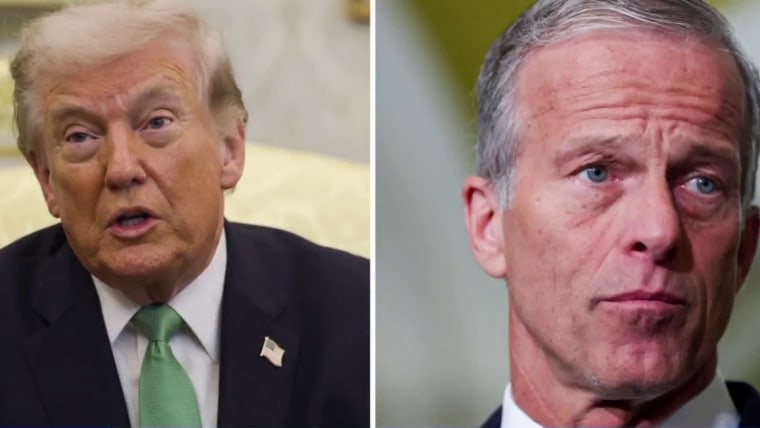
WASHINGTON — On Sunday, Senate Majority Leader John Thune, R-S.D., discussed an off-ramp with President Donald Trump to reopen TSA and end the long lines and delays at airports.

It would fund all of the Department of Homeland Security except for ICE, which Democrats have refused to support without new limitations on immigration enforcement operations, two sources with knowledge of the conversation told NBC News.

White House aides initially conveyed the idea to Trump and, after that briefing, Thune spoke with the president, the two sources said. Thune discussed the idea with Republicans on Capitol Hill, one of the sources said. The second source said it’s seen by numerous Republicans as a viable path to break the logjam.

ICE would be funded separately by Republicans in a party-line “reconciliation” bill that can pass without the need for any Democratic support later in the year.

The Department of Homeland Security has been shut down for more than a month, and while key operations, such as TSA and the Federal Emergency Management Agency, are still operating, many of those employees are working without pay. As NBC News reported this weekend, more than 400 TSA officers have quit since the shutdown began. Immigration and Customs Enforcement is also shut down, but its employees are being paid through Trump’s big beautiful bill passed last year.

Republicans believe that the off-ramp Trump and Thune discussed would win support from Democrats, who have offered to fund noncontroversial parts of the Department of Homeland Security on the Senate floor while the two parties continue to negotiate on immigration.

But Trump rejected it — as he made clear in a Truth Social post Sunday night.

“I don’t think we should make any deal with the Crazy, Country Destroying, Radical Left Democrats unless, and until, they Vote with Republicans to pass ‘THE SAVE AMERICA ACT,’” Trump wrote, while instead calling on Republicans to “Kill the Filibuster, and stay in D.C. for Easter, if necessary.”

Trump’s first two ideas aren’t viable. Democrats are determined to sink the SAVE America Act, which doesn’t have enough support to pass. And Republicans have made clear they lack the votes to nuke the filibuster. They may, however, cancel recess if there’s still no deal by the end of this week.

The conversation with Thune and Trump was first reported by Punchbowl News.

Speaking Monday in Memphis, Tennessee, the president doubled down on his demands to pair Homeland Security funding with the voting bill.

“You don’t have to take a fast vote. Don’t worry about Easter, going home. In fact, make this one for Jesus. OK, make this one for Jesus,” Trump said, adding: “The most important part of homeland security is voter ID and proof of citizenship. Nobody can vote on Homeland Security without voter ID or proof of citizenship.”

Senate Minority Leader Chuck Schumer’s office said that Democrats will again seek unanimous consent to fund just the TSA on the Senate floor Monday, for the eighth time.

Republicans have so far rejected those stand-alone bills.

If Trump were to change his mind and accept the Thune-GOP idea, it carries benefits for both parties. For Republicans, they could avoid giving into Democratic demands, such as requiring immigration enforcement officers to remove their masks and requiring judicial warrants to conduct raids. For Democrats, they could keep their fingerprints off ICE funding, which has become toxic with their base since Homeland Security agents killed protesters Alex Pretti and Renee Good in Minneapolis.

“We can be out of this shutdown by the end of the week,” Sen. John Kennedy, R-La., said Sunday. “Here’s what we do. The Democrats are amenable to opening up everything at DHS but ICE. We should accept that. The very next day, we should file a budget resolution through reconciliation that funds ICE as we deem appropriate. We don’t need Democratic votes to do that.”

Democrats are also planning to seize on the Trump social media post to argue that he owns the shutdown and travel chaos.

Reconciliation bills are arduous, requiring near-unanimous support among Republicans, especially given the tiny House majority. There has been deep skepticism that the party could pull it off, even if it tried. But needing to fund an agency like ICE would raise the impetus to use that path.

Under the “big, beautiful bill” passed by Republicans last year, ICE received a cash infusion of about $75 billion for the next four years to help carry out Trump’s mass deportation program.

The path comes with another possible upside for the White House: Some Trump allies have proposed reconciliation to approve supplemental funding for Trump’s war in Iran. It’s not clear that could win enough Democratic support.

(TheNewswire)

Brossard, Quebec TheNewswire – le 12 mars 2026 CORPORATION Charbone (TSXV: CH,OTC:CHHYF; OTCQB: CHHYF; FSE: K47) (« Charbone » ou la « Société »), un producteur et distributeur nord-américain spécialisé dans l’hydrogène propre Ultra Haute Pureté (« UHP ») et les gaz industriels stratégiques, est heureuse d’annoncer sa participation à la conférence Hydrogen East du 13 avril 2026, ainsi que le développement d’un hub d’approvisionnement dédié à l’hydrogène UHP et aux gaz de spécialité stratégiques dans le marché du Canada Atlantique (« Hub Atlantique »).

Cette initiative marque une nouvelle étape dans la stratégie de déploiement de Charbone visant à établir un réseau intégré de hubs de production, stockage et distribution d’hydrogène et de gaz industriels stratégiques en Amérique du Nord.

Le futur Hub Atlantique qui sera géré par sa filiale Charbone Nouvelle-Écosse Inc. et opérationnel d’ici juin 2026, servira d’installation physique dédiée au stockage local et à la distribution régionale, permettant d’assurer un approvisionnement fiable et flexible en hydrogène pour une variété d’utilisateurs industriels exigeants, incluant les secteurs de la défense, de la fabrication avancée, de la mobilité et des infrastructures énergétiques.

Charbone est active dans la région de l’Atlantique depuis plus de trois (3) années et a développé une connaissance approfondie des marchés de la Nouvelle-Écosse, du Nouveau-Brunswick et de l’Île-du-Prince-Édouard, tout en travaillant sur différentes initiatives avec des clients et partenaires potentiels d’envergure, notamment dans les domaines suivants :

  • infrastructures portuaires 

  • chantiers navals et installations de la Marine canadienne 

  • chaîne d’approvisionnement de composantes automobiles 

  • entreprises de services publics et énergétiques 

  • entreprises de recherche et développement 

  • solutions de transport avancées à éro émission 

Ce modèle « hub-and-spoke » constitue un pilier de la stratégie de Charbone visant à déployer progressivement un réseau évolutif de hubs d’approvisionnement en hydrogène et en gaz industriels stratégiques à travers le Canada et les États-Unis, permettant de soutenir les marchés régionaux grâce à des capacités locales de stockage, de logistique et de distribution.

« La région du Canada Atlantique représente un marché stratégique pour Charbone, notamment en raison de la présence d’infrastructures de grandes qualités, d’utilisateurs industriels d’envergures et d’initiatives de transition énergétique, » a déclaré Dave B. Gagnon, PDG de Charbone. La Société prévoit que ce hub jouera un rôle structurant dans le développement de sa future plateforme logistique nord-américaine de l’hydrogène. »

Pour plus de détails sur la Conférence Hydrogen East, veuillez cliquer sur le lien ci-bas :

À propos de CORPORATION Charbone

Charbone est un développeur et producteur d’hydrogène propre Ultra Haute Pureté (UHP) doté d’une plateforme de distribution de gaz industriels en pleine expansion. Grâce à une approche modulaire, Charbone se concentre sur le développement d’un réseau d’usines de production d’hydrogène propre en Amérique du Nord et sur certains marchés à l’étranger, en commençant par son projet phare de Sorel-Tracy au Québec. Le modèle intégré de l’entreprise réduit les risques, améliore l’évolutivité et permet de diversifier ses sources de revenus grâce à des partenariats dans le domaine de l’hélium et d’autres gaz de spécialités. Charbone s’engage à soutenir la transition mondiale vers une économie bas carbone en fournissant des solutions d’hydrogène propre et de gaz de spécialités accessibles et décentralisées, tout en soutenant les clients industriels mal desservis en gaz et en accélérant la transition vers une énergie propre locale. Charbone est coté sur la bourse de croissance TSX (TSXV: CH,OTC:CHHYF); sur les marchés OTC (OTCQB: CHHYF); et à la Bourse de Francfort (FSE: K47). Pour plus d’informations, veuillez visiter www.charbone.com.

Énoncés prospectifs

Le présent communiqué de presse contient des énoncés qui constituent de « l’information prospective » au sens des lois canadiennes sur les valeurs mobilières (« déclarations prospectives »). Ces déclarations prospectives sont souvent identifiées par des mots tels que « a l’intention », « anticipe », « s’attend à », « croit », « planifie », « probable », ou des mots similaires. Les déclarations prospectives reflètent les attentes, estimations ou projections respectives de la direction de Charbone concernant les résultats ou événements futurs, sur la base des opinions, hypothèses et estimations considérées comme raisonnables par la direction à la date à laquelle les déclarations sont faites. Bien que Charbone estime que les attentes exprimées dans les déclarations prospectives sont raisonnables, les déclarations prospectives comportent des risques et des incertitudes, et il ne faut pas se fier indûment aux déclarations prospectives, car des facteurs inconnus ou imprévisibles pourraient faire en sorte que les résultats réels soient sensiblement différents de ceux exprimés dans les déclarations prospectives. Des risques et des incertitudes liés aux activités de Charbone peuvent avoir une incidence sur les déclarations prospectives. Ces risques, incertitudes et hypothèses comprennent, sans s’y limiter, ceux décrits à la rubrique « Facteurs de risque » dans le rapport de gestion de la Société pour la période terminée le 30 septembre 2025, qui peut être consultée sur SEDAR+ à l’adresse www.sedarplus.ca; ils pourraient faire en sorte que les événements ou les résultats réels diffèrent sensiblement de ceux prévus dans les déclarations prospectives.

Sauf si les lois sur les valeurs mobilières applicables l’exigent, Charbone ne s’engage pas à mettre à jour ni à réviser les déclarations prospectives.

Ni la Bourse de croissance TSX ni son fournisseur de services de réglementation (tel que ce terme est défini dans les politiques de la Bourse de croissance TSX) n’acceptent de responsabilité quant à la pertinence ou à l’exactitude du présent communiqué.


Contact Corporation Charbone

Téléphone: +1 450 678 7171

Courriel: ir@Charbone.com

Benoit Veilleux

Chef de la direction financière et secrétaire corporatif


Copyright (c) 2026 TheNewswire – All rights reserved.

News Provided by TheNewsWire via QuoteMedia

This post appeared first on investingnews.com

Tartisan Nickel Corp. (CSE: TN,OTC:TTSRF) (OTCQX: TTSRF) (FSE: 8TA) (‘Tartisan’, or the ‘Company’) is pleased to provide an update on the Phase 1 diamond drill program at the Company’s Kenbridge Nickel-Copper-Cobalt Project, Sioux Narrows, Northwestern Ontario. The Phase 1 drill program was designed to test the on strike and down dip potential for additional nickel sulphide mineralization to enhance the size and grade of the Kenbridge Deposit.

A total of 3,191m of drilling has been completed to date. The first 4 drill targets have been completed (drill holes KB26-207, KB26-208, KB26-209 and KB26-210 outlined on Figure 1). Samples were delivered to AGAT Labs in Thunder Bay for analysis.

Reported in this release are the results from the 4th hole KB26-210. Results from the hole confirm both A and B zones were intersected as outlined in the Table 1 below. Zone A was intersected from 762.4 to 787.0m drill depth and returned 0.71% Ni, 0.56% Cu over 24.6 metres including 6.1m of 1.17% Ni, 1.45% Cu from 762.4 to 768.5m drill depth and 2.0 m of 1.73% Ni, 0.31% Cu from 774.5 to 776.5m drill depth. Zone B was intersected from 800.2m to 806.0m drill depth. Results were 0.27% Ni, 0.24% Cu over 5.8 metres. Drill core intersection widths are estimated to be between 65 and 80% true width.

Fig 1: Long section of Kenbridge deposit showing drilling targets. Completed or holes in progress are outlined in red circles.

To view an enhanced version of this graphic, please visit:
https://images.newsfilecorp.com/files/1492/288216_d63210af3456385c_002full.jpg

Mark Appleby, CEO of Tartisan Nickel Corp., stated, ‘The KB26-210-hole result represents a significant high-grade intercept. We are very encouraged to see the wider intersection as the deposit appears to now flare outwards at depth. Intersecting 24.6 metres of 0.71% Ni and 0.56% Cu including higher grade portions (1.17% Ni, 1.45% Cu over 6.1m and 1.73% Ni, 0.31% Cu over 2.0m) confirms continuity of significant nickel-copper mineralization in this system. These results will strengthen our ability and confidence in upgrading our resource and in the project’s overall potential. While we have now taken a brief pause for spring break up, the company will introduce Borehole EM down the drill holes completed in Phase 1 and commence Phase 2 drilling this spring. We look forward to drilling below the existing shaft bottom to test for the depth extension to the deposit shortly.’

Table 1: Highlight intervals (* denotes hole reported in this release)

To view an enhanced version of this graphic, please visit:
https://images.newsfilecorp.com/files/1492/288216_table1.jpg

The Kenbridge Property is in the Kenora Mining District, Sioux Narrows, Ontario, Canada with all-season road access. The Kenbridge Deposit has an existing shaft to a depth of 2,042 ft (622 m), with level stations at 150 ft. (45 m) intervals below the shaft collar and two levels developed at 350 ft (107 m) and 500 ft (152 m) below the shaft collar.

Surveyed Hole Locations (Coordinates in UTM zone 15)

To view an enhanced version of this graphic, please visit:
https://images.newsfilecorp.com/files/1492/288216_table2.jpg

Qualified Person

The technical information in this news release has been prepared in accordance with Canadian regulatory requirements as set out in NI 43-101 and reviewed and approved by Dean MacEachern, P. Geo., an Independent Consultant to the Company and a Qualified Person as defined by NI 43-101.

QA/QC

Sample QA/QC procedures for Tartisan have been designed to meet or exceed industry standards. Drill core is collected from the diamond drill and placed in sealed core trays for transport to on-site sampling and core cutting facilities. The core is logged and samples taken from 0.3m to a maximum sample length of 1.5m. The core samples are split with a diamond blade saw with continuous running water, half of the sample is sent for lab testing, and the remaining half core is left in the core box for record or further sampling. The core samples are bagged in heavy plastic bags with 6 samples being placed into a rice bag for transport to AGAT Laboratories in Thunder Bay, ON or Calgary, AB for assay. Samples are submitted in batches of 50. 100g blind certified reference materials (CRMs) from CDN Resources, as well as, duplicates and blank samples are systematically inserted by the Company into the sample stream with reference to the mineralization in the sampled rock and analyzed as part of the Company’s quality assurance/quality control protocol, as well, AGAT labs implements their own quality control testing by inserting their own CRMs and Blanks in the sample stream for accredited testing.

All drill core samples were prepped and analyzed at AGAT Laboratories in Thunder Bay, Ontario or shipped to Calgary for testing. An ISO/IEC 17025 2017 certified independent laboratory from organizations like the Standards Council of Canada (SCC), the Canadian Association for Laboratory Accreditation (CALA), ANSI National Accreditation Board (ANAB) and the American Association of Laboratory Accreditation (A2LA). They maintain accreditations across their facilities in Alberta, Saskatchewan, Ontario, Nova Scotia, Newfoundland, Quebec and internationally.

NQ-diameter sawed half-core samples from the drilling program were securely sent by Tartisan Nickel Corp’s geologists to AGAT Laboratories Ltd. (AGAT), with sample preparation in Thunder Bay, Ontario, and analysis in Thunder Bay, Ontario & Calgary, Alberta. Samples were processed for Au, Pt and Pd analysis by 50-gram fire assay with ICP-OES finish and for four acid digestion, multi-element analysis by inductively coupled plasma & mass spectrometry (ICP OES + MS). AGAT sample preparation and laboratory analysis procedures conform to requirements of ISO/IEC Standard 17025 guidelines and meet the requirements under NI 43-101 and CIM best practice guidelines. AGAT Laboratories is independent of Tartisan Nickel Corp.

Samples were dried and crushed to 2 mm, from which a 250 g sub-sample split was then pulverized to 85% passing a 75 micron sieve. Following preparation, assays were determined by the ICP OES method. A 0.25 g aliquot of the prepared pulp was digested in a 4-acid solution consisting of hydrochloric, nitric, perchloric and hydrofluoric acids. 4-acid is a near total digest and only the most highly resistant minerals are not dissolved. The resulting solution was analyzed via ICP-MS and ICP-ES for 8 elements and was corrected for inter-element spectral interferences. Lower detection limits for this procedure are 0.01 ppm for nickel, 0.01 ppm for copper, 0.01 ppm for cobalt, 0.01 ppm for platinum, 0.01 ppm palladium, 0.01 ppm silver and 0.01 ppm for gold.

Samples with initial results beyond the upper detection limit of the ICP OES method were analyzed by (201-071) 4 acid digest – Metals Package, ICP-OES/ICP-MS finish (CGY). The thresholds are >1% for nickel, copper and cobalt. AGAT Laboratories employs internal quality control standards, duplicates and blank samples at set frequencies. Tartisan Nickel Corp. stores all its drilled core on-site and takes pride in its facilities and strives for excellence in its QA/QC procedures.

About Tartisan Nickel Corp.

Tartisan Nickel Corp. is a Canadian-based critical minerals exploration and development company which owns, the Kenbridge Nickel-Copper Project near Sioux Narrows, Northwestern Ontario, the Sill Lake Silver Project near Sault Ste. Marie, Ontario as well as the Night Danger Turtle Pond Project near Dryden, Ontario.

Tartisan Nickel Corp. common shares are listed on the Canadian Securities Exchange (CSE: TN,OTC:TTSRF) (OTCQX: TTSRF) (FSE: 8TA). Currently, there are 152,215,641 shares issued and outstanding (156,287,356 fully diluted).

For further information, please contact Mark Appleby, President & CEO, and a Director of the Company, at 416-804-0280 (info@tartisannickel.com). Additional information about Tartisan Nickel Corp. can be found at the Company’s website at www.tartisannickel.com or on SEDAR+ at www.sedarplus.ca.

This news release may contain forward-looking statements including but not limited to comments regarding the timing and content of upcoming work programs, geological interpretations, receipt of property titles, potential mineral recovery processes, etc. Forward-looking statements address future events and conditions and therefore involve inherent risks and uncertainties. Actual results may differ materially from those currently anticipated in such statements.

The Canadian Securities Exchange (operated by CNSX Markets Inc.) has neither approved nor disapproved of the contents of this press release.

To view the source version of this press release, please visit https://www.newsfilecorp.com/release/288216

News Provided by TMX Newsfile via QuoteMedia

This post appeared first on investingnews.com