Author

admin

Browsing

Cartier Resources Inc. (″ Cartier ″ or the ″ Company ″) (TSXV: ECR,OTC:ECRFF; FSE: 6CA) is pleased to announce it has awarded the contract to Soutex, a firm specializing in mineral processing and metallurgy, to carry out the first advanced and comprehensive metallurgical sampling and testwork program for the Main Sector of its Cadillac Project.

Key Objectives of the Program

  • Defining expected gold recovery rates and improving upon historical results from the Chimo deposit.
  • Establishing first-time metallurgical recovery data for the East Chimo and West Nordeau satellite deposits, where no previous data exists.
  • Supporting the development of an integrated process flowsheet .
  • Providing critical data for future trade-off studies to guide project development.

The metallurgical program represents a critical de-risking milestone to advance the development of the Cadillac Project. By understanding how the mineralized material responds to conventional processing methods, we can define the most efficient and cost-effective flowsheet. This has the potential to significantly reduce both capital and operating costs, while also improving our environmental footprint. The data generated will directly support optimized project development and enhance our economic models. In short, these test results will strengthen the technical foundation of the project and help unlock greater shareholder value . ‘ – Philippe Cloutier, President and CEO of Cartier.

Following the recent launch of baseline environmental studies, we’re pleased to advance the Cadillac Project with the initiation of our first modern metallurgical test program. With historical data now nearly 30 years old, it was essential for Cartier to generate updated, high-quality data that reflects current standards. This comprehensive program will characterize the mineralized material, gold recovery potential, and validate optimal grind size (key inputs for future engineering and economic studies). Combined with our ongoing 100,000-metre drill program, these initiatives position us to unlock the full value of the Cadillac Project. ‘ – Ronan Deroff, Vice President Exploration of Cartier.

Historical Production Recovery (source: MRNF DV 85-05 to DV 97-01 + internal company reports)

The mineralized material from the Chimo mine (Chimo deposit) was processed by 3 different producers: Chimo Gold Mines (1966-67), Louvem (1984-1989) and Cambior (1989-1997). The flowsheet was focused on gravity separation, flotation and cyanidation of flotation concentrate. Records show that from 1966 through 1997, approximatively 2.4 million tonnes of mineralized material have been processed. During the 15-year period production, the historical average recovery was 90.6% of the contained gold. These numbers appear to underestimate the deposit and should be able to improve, since the first two operators of the Chimo mine (Chimo Gold Mines and Louvem) had good extraction results, around 94%, while the last production period by Cambior showed a significant drop in recoveries with only 89% of the contained gold.

There is no metallurgical information available for the other deposits of the Main Sector like East Chimo and West Nordeau deposits.

Methodology of the Metallurgical Testwork Program

To achieve the program objectives, the testwork will be conducted on NQ-size half-drill core intervals spatially selected to be representative of both the type of mineralization and the average head grade of the resource. A total of 6 composites for 300 kg from the three deposits (Chimo, East Chimo and West Nordeau) will be generated including two 50 kg-composites for each deposit. The composites will be assembled by Cartier geologists.

All composites of the three deposits will be subject to cyanidation tests at three different grind sizes. After these tests, gravimetric concentration separation followed by a cyanide destruction tests of the gravity tails will be done at the grind size showing the best results. In addition to the metallurgical program, comminution test, as well as chemical and mineralogical characterization, will also be performed to define the grindability of the mineralized material and predict his behaviour in the process.

Qualified Person

The scientific and technical content of this press release has been prepared, reviewed and approved by Mr. Ronan Déroff, P.Geo., M.Sc., Vice President Exploration, who is a ″Qualified Person″ as defined by National Instrument 43-101 – Standards of Disclosure for Mineral Projects (″NI 43-101″).

About Soutex

Soutex is a consulting firm in mineral processing and metallurgy that offers specialized services, from the initial stages of development on paper to the daily operations of the processing plant. Their designs stem from their solid experience in providing plant operations support. This support is based on their knowledge of fundamental ore processing principles and their in-plant experience. Founded in 2000 and having offices in Canada (Quebec and Longueuil) and Germany (Munich), Soutex comprises more than 40 metallurgists, process engineers, and technicians, making it one of the largest groupings of specialists in the field in Canada. Services have been offered to clients located across Canada and abroad (West Africa, United States, Finland, New Caledonia, Suriname, and Madagascar).

About Cadillac Project

The Cadillac Project, covering 14,000 hectares along a 15-kilometre stretch of the Cadillac Fault, is one of the largest consolidated land packages in the Val-d’Or mining camp. Cartier’s flagship asset integrates the historic Chimo Mine and East Cadillac projects, creating a dominant position in a world class gold mining district. With excellent road access, year-round infrastructure and nearby milling capacity, the project is ideally positioned for rapid advancement and value creation.

Using a gold price of US$1,750/oz, a Preliminary Economic Assessment demonstrated the economic viability of a 2-km segment, compared to the 15 km that will be the subject of the 100,000 m drilling program, with an average annual gold production of 116,900 oz over a 9.7-year mine life. Indicated resources are estimated at 720,000 ounces (7.1 million tonnes at 3.1 g/t Au) and inferred resources at 1,633,000 ounces (18.5 million tonnes at 2.8 g/t Au). Please see the NI 43-101 ″Technical Report and Preliminary Economic Assessment for Chimo Mine and West Nordeau Gold Deposits, Chimo Mine and East Cadillac Properties, Quebec, Canada, Marc R. Beauvais, P.Eng., of InnovExplo Inc., Mr. Florent Baril of Bumigeme and Mr. Eric Sellars, P.Eng. of Responsible Mining Solutions″ effective May 29, 2023.

About Cartier Resources Inc.

Cartier Resources Inc., founded in 2006 and headquartered in Val-d’Or (Quebec) is a gold exploration company focused on building shareholder value through discovery and development in one of Canada’s most prolific mining camps. The Company combines strong technical expertise, a track record of successful exploration, and a fully funded program to advance its flagship Cadillac Project. Cartier’s strategy is clear: unlock the full potential of one of the largest undeveloped gold landholdings in Quebec.

For further information, contact:
Philippe Cloutier, P. Geo.
President and CEO
Telephone: 819-856-0512
philippe.cloutier@ressourcescartier.com
www.ressourcescartier.com

Neither TSX Venture Exchange nor its Regulation Services Provider (as that term is defined in policies of the TSX Venture Exchange) accepts responsibility for the adequacy or accuracy of this release.

News Provided by GlobeNewswire via QuoteMedia
This post appeared first on investingnews.com

Investor Insight

With a growth-oriented strategy, Golconda Gold is positioning itself as one of the highest-torque junior gold producers in the sector with assets in prolific gold districts in South Africa and the US. For investors bullish on gold, Golconda is a unique opportunity: a profitable producer with meaningful growth ahead, exposure to both gold and silver, and the discipline to deliver shareholder value in a capital-efficient way.

Overview

Golconda Gold (TSXV:GG;OTCQB:GGGOF) is an unhedged gold producer and explorer with operations in South Africa and the United States. The company is focused on optimizing its current mining and processing operations, reducing costs, and growing organically while pursuing accretive acquisition opportunities.

Its growth story is underpinned by two cornerstone assets: Galaxy Gold, the company’s cash-flowing, long-life South African operation; and Summit, a high-grade silver-gold project in New Mexico poised for a restart. Galaxy provides a steadily growing, self-funded production base, while Summit is positioned as the next major catalyst for Golconda, broadening investor exposure to silver and US operations. These assets enable Golconda to deliver meaningful production growth without dilution, providing investors direct leverage to gold prices at a time when juniors remain undervalued relative to commodity prices.

With strong insider ownership and a disciplined approach to capital, Golconda offers investors a unique combination of operating stability, near-term growth and upside exploration potential.

Company Highlights

  • Significant Production Growth: On track to triple production over three years at Galaxy while bringing Summit online in Q2 2026.
  • Summit Restart and Spin-out: Fully permitted past-producing mine in New Mexico, expected to restart in Q2 2026 and spin out as a standalone US-focused gold-silver producer in Q4 2026.
  • No Dilution Strategy: Growth funded through operating cash flow rather than equity raises, ensuring torque to gold without shareholder dilution.
  • Insider Alignment: Management and insiders control more than 40 percent of shares, aligning leadership directly with shareholder interests.
  • Jurisdictional Strengths: Operations in South Africa’s Barberton Greenstone Belt (long history of gold mining, strong infrastructure) and in the US southwest.
  • Exploration Upside: Both Galaxy and Summit hold substantial untested upside with additional ore bodies and underexplored zones.

Key Projects

Galaxy Gold Mine

Galaxy is Golconda’s cornerstone asset and currently the company’s sole producing mine. Situated in the Barberton Greenstone Belt, one of South Africa’s most prolific gold districts with nearly 150 years of mining history, the mine benefits from established infrastructure, sealed-road access and proximity to skilled mining services. The property hosts a large resource base of 941,000 oz of gold in the measured and indicated categories grading 2.79 grams per ton (g/t), plus 1.37 million oz (Moz) inferred at 2.62 g/t.

Snapshot of Galaxy Gold Mine Operations

The operation is an underground, trackless mechanized mine, currently producing at a run rate of ~12,000 oz/year, with a multi-stage ramp-up plan to 25,000 oz/year by 2027 and up to 45,000 oz/year by 2028. Ore is processed through a 50,000 tonnes per month (tpm) crush-mill-float plant, which was refurbished with a new mill, concentrate tanks, and a filter press. The plant is already capable of handling the full ramp-up capacity, allowing it to expand with minimal capital outlay.

Galaxy produces a refractory gold concentrate sold directly to Ocean Partners, eliminating the need for BIOX or other complex high-capex processing routes. This low-risk sales model enables Galaxy to operate profitably and reinvest cash flow into mine development. The mine plan leverages both the Princeton and Galaxy ore bodies, with development into additional levels and ore bodies among the 21 known mineralized zones on the property. Over its history, Galaxy (formerly, the Agnes mine) has produced more than 1.3 Moz of gold, with current exploration drilling continuing to identify significant upside at depth and along strike.

Economically, Galaxy is highly accretive: at $3,000/oz gold, the operation generates an after-tax NPV5 percent of US$201 million, with life-of-mine free cash flow exceeding US$270 million on conservative assumptions. The operation has a projected all-in sustaining cost (AISC) of ~US$1,000/oz once ramp-up is complete, positioning it competitively within the global cost curve.

Summit Gold-Silver Mine and Banner Mill

The Summit mine, located in the Steeple Rock Mining District of southwestern New Mexico, is a high-grade past-producing underground operation. The New Mexico portfolio also includes the Banner mill, a 240 tpd flotation facility located 57 miles from Summit via paved highways and sealed roads. Golconda acquired the project from Waterton in 2021, along with a streamlined land package totaling ~4,000 acres of patented and unpatented claims.

Summit Mine and Banner Mills snapshot

Summit hosts a defined resource of 1.4 Moz silver and 26,000 oz gold in measured and indicated categories, plus 5.1 Moz silver and 74,000 oz gold inferred. The mine is fully permitted and is expected to restart in Q2 2026, with first concentrate production within 9 to 12 months. The restart strategy is fully funded internally from Galaxy cash flows, ensuring no dilution to shareholders.

The planned annual production profile targets ~10,000 oz gold and 444,000 oz silver at steady state, with an average AISC of US$1,600/oz gold equivalent. At $3,000/oz gold and $35/oz silver, Summit delivers an after-tax NPV5 percent of US$105 million, with cumulative free cash flow of ~US$135 million over its mine life. The project is structured to be spun out into a standalone US-only gold-silver producer by Q4 2026, broadening investor appeal and potentially unlocking a higher valuation multiple.

The Banner Mill 240-tpd flotation facility 57 miles from the Summit mine

Exploration upside at Summit is significant. The Billali Zone, northwest of the main deposit, has returned historical intercepts including 681 g/t silver and 9.38 g/t gold over 4.4 m and hosts a 1992 historical resource of 288,000 tonnes grading 121 g/t silver and 3.67 g/t gold. The nearby Mohawk Area features a 2,000 ft IP anomaly with drill intercepts including 1.5 m at 437.5 g/t silver and 9.34 g/t gold at depth. Both zones remain open and underexplored, providing clear potential to extend mine life and scale production.

Summit’s restart and planned spin-out will give Golconda a second producing asset in a Tier 1 jurisdiction, diversify its commodity mix with silver exposure, and broaden its investor base, while maintaining the company’s no-dilution philosophy.

Management Team

Ravi Sood – Chairman and CEO

Ravi Sood has more than 25 years of experience in capital markets and operations. He is the founder and former CEO of Navina Asset Management, and director of Elemental Altus Royalties and Sparq Systems. He founded and/or co-founded multiple companies in mining, energy and renewables.

Andrew Bishop – Chief Financial Officer

A chartered accountant with more than 22 years of financial and mining experience in Africa and North America, Andrew Bishop brings strong financial discipline and operational insight to Golconda. He was previously with Aureus Mining, Avesoro Resources and Golden Star.

Wayne Hatton Jones – Chief Operating Officer

Wayne Hatton Jones is a mining professional with 38 years of experience in Africa, Asia and Europe. He previously worked at Goldridge, Avocet, Randgold and Harmony. His expertise includes mine development, metallurgy and operations.

This post appeared first on investingnews.com

Copper Quest Exploration (CSE:CQX, OTCQB:IMIMF, FRA:3MX) is focused on creating shareholder value through the exploration and development of its North American critical mineral portfolio, with more than 40,000 hectares across tier-one jurisdictions in Canada and the US.

In British Columbia, the company’s assets include the Stars copper-molybdenum discovery in the Bulkley Porphyry Belt, the Stellar property with historic showings and new anomalies, an earn-in on the Rip project, a large porphyry copper-molybdenum system, and the Thane Project in the Toodoggone Belt, prospective for copper-gold-molybdenum.

The Stars project is a 9,694-hectare, road-accessible copper-molybdenum property in the prolific Bulkley Porphyry Belt, home to past producers such as Imperial Metals’ Huckleberry mine and Newmont’s Equity Silver Mine. Stars is defined by a 5 × 2.5 km annular magnetic anomaly coincident with a mineralized monzonite intrusion. Drilling in 2018 confirmed a significant porphyry system at the Tana Zone, highlighted by intercepts of 0.466 percent copper over 195.1 meters from 23 meters, including 40 meters averaging nearly 1 percent copper, and 0.20 percent copper over 396.7 meters from 28 meters. All holes to date have returned copper levels well above background, with alteration, intrusive textures, and veining typical of productive porphyry systems.

Company Highlights

  • Large, Tier-one Land Position: More than 40,000 hectares across British Columbia’s Bulkley and Toodoggone Porphyry Belts, plus a newly acquired copper-gold porphyry project in Idaho, USA.
  • Flagship Discovery at Stars: Drill intercepts of 0.466 percent copper over 195.1 m confirm a fertile porphyry copper-molybdenum system with over 30 km of untested intrusive contacts.
  • Multiple Copper Systems: Canadian portfolio includes Stars, Stellar, Rip (earn-in up to 80 percent) and Thane, each offering district-scale potential in proven belts.
  • Idaho Acquisition: The Nekash copper-gold porphyry project in Lemhi County, Idaho, is a milestone acquisition aligned with its strategy to build a portfolio of highly prospective copper assets across North America.

This Copper Quest Exploration profile is part of a paid investor education campaign.*

Click here to connect with Copper Quest Exploration (CSE:CQX) to receive an Investor Presentation

This post appeared first on investingnews.com

Golconda Gold (TSXV:GG) is a growth-focused junior producer with operations in prolific gold districts in South Africa and the US. Positioned as one of the sector’s highest-torque opportunities, Golconda offers investors profitable production, exposure to both gold and silver, and a disciplined, capital-efficient path to meaningful growth.

Golconda Gold is anchored by two cornerstone assets: Galaxy, its cash-flowing South African gold mine, and Summit, a high-grade silver-gold project in New Mexico set for restart. Together, they provide self-funded growth, U.S. exposure, and strong leverage to rising gold prices.

Galaxy, Golconda’s cornerstone asset, is a producing mine in South Africa’s prolific Barberton Greenstone Belt. The operation hosts 941,000 oz gold (M&I, 2.79 g/t) and 1.37 Moz inferred (2.62 g/t), supported by strong infrastructure and access to skilled mining services.

Company Highlights

  • Significant Production Growth: On track to triple production over three years at Galaxy while bringing Summit online in Q2 2026.
  • Summit Restart and Spin-out: Fully permitted past-producing mine in New Mexico, expected to restart in Q2 2026 and spin out as a standalone US-focused gold-silver producer in Q4 2026.
  • No Dilution Strategy: Growth funded through operating cash flow rather than equity raises, ensuring torque to gold without shareholder dilution.
  • Insider Alignment: Management and insiders control more than 40 percent of shares, aligning leadership directly with shareholder interests.
  • Jurisdictional Strengths: Operations in South Africa’s Barberton Greenstone Belt (long history of gold mining, strong infrastructure) and in the US southwest.
  • Exploration Upside: Both Galaxy and Summit hold substantial untested upside with additional ore bodies and underexplored zones.

This Goldconda Gold profile is part of a paid investor education campaign.*

Click here to connect with Goldconda Gold (TSXV:GG) to receive an Investor Presentation

This post appeared first on investingnews.com

(TheNewswire)

GRANDE PRAIRIE, AB, (September 30, 2025): – TheNewswire – Angkor Resources Corp. (TSXV: ANK and OTC: ANKOF) (‘Angkor’ or ‘the Company’) announces its energy subsidiary, EnerCam Resources Co. Ltd. (Cambodia) (‘EnerCam’) has completed the onshore 350-line kilometer 2D seismic program on Block VIII, including the newly added area of Mussel Basin.

The seismic program is the first onshore seismic for the Kingdom of Cambodia since preliminary lines were shot in 2008 and in 2013.   The Company contracted and used EnviroSeis equipment for low impact and high data coverage.  The seismic program covered areas across the four provinces of Sihanoukville, Kampong Speu, Koh Kong and Kampot.

President of EnerCam, Mike Weeks commented on the program, ‘We are so impressed with the quality of work from our local staff, who worked through some less than optimal weather conditions to help facilitate acquiring this valuable data.   We will be completing a preliminary assessment of the data as it becomes available and then a secondary assessment to hopefully define drill targets.’

Processing and interpretation of the data from the 350-line kilometers will occur over several months by multiple parties and is expected to arrive in segments as each seismic line is processed.

Full length of the program was 47 days, starting at 5:00 am daily with standard safety and tailgate meetings and then crews deployed for three rotational activities, namely:

  • to go ahead of vibration units to place geophones and data recorders along designated paths;

  • to go sweep an area already installed with recorders and geophones with vibration units; and

  • to go behind the areas of completed sweeps and pick up recorders and geophones to deploy to the next proposed line.

A team of 53 people participated in training and then worked 12-hour days, seven days per week to accomplish the program.   Of the personnel, 13 Thai came in as part of the contracted team and the remaining 40 were Khmer people, the majority of which were from local villages and 12 of them were trainees from the Institute of Technology in their 4 th or 5 th year of their geoscience studies.

Keith Edwards, Technical Manager for EnerCam, had these words, ‘We have seen the preliminary processing (brute stack) for 9 of the 24 lines and can already see a broad, closed structure with some parallel beds and some more complex stratigraphy with amplitude bright spots.  With no wells we won’t know for sure what formations we are dealing with until we drill.  We have acquired the data in such a manner to get ‘extra’ coverage by having live receivers on nearby parallel lines.  This gives us additional coverage in key areas that we hope will allow us to see the complex reflectors in map view. as a ‘poor mans 3D’.  The figure below shows the midpoint density map without and with recording on nearby lines.’

Click Image To View Full Size


Click Image To View Full Size

Figure 2 Outline of Block VIII with red seismic lines completed in the program and the additional Mussel Basin outlined in the northeast section.

ABOUT Angkor Resources CORPORATION:

Angkor Resources Corp. is a public company, listed on the TSX-Venture Exchange, and is a leading resource optimizer in Cambodia working towards mineral and energy solutions across Canada and Cambodia. ANGKOR’s carbon capture and gas conservation project in Saskatchewan, Canada is part of its long-term commitment to Environmental and Social projects and cleaner energy solutions across jurisdictions.  The company’s mineral subsidiary, Angkor Gold Corp. in Cambodia holds three mineral exploration licenses in Cambodia and its Cambodian energy subsidiary, EnerCam Resources, was granted an onshore oil and gas license of 7300 square kilometers in the southwest quadrant of Cambodia called Block VIII.  The license was reduced to roughly half the size with the Company’s voluntary removal of all parks and protected areas in March 2025 and 220 square kilometers were added in August 2025; making the license a current area of 4277 square kilometers.  Since 2022, Angkor’s Canadian subsidiary, EnerCam Exploration Ltd., has been involved in gas/carbon capture and oil and gas production in Evesham, Saskatchewan.

CONTACT: Delayne Weeks – CEO

Email: info@angkorresources.com Website: angkor resources.com

Telephone: +1 (780) 831-8722

Please follow @AngkorResources on , , , Instagram and .

Certain information set out in this news release constitutes forward-looking information within the meaning of applicable securities laws. Forward-looking information is often, but not always, identified by the use of words such as ‘seek’, ‘anticipate’, ‘hope’, ‘plan’, ‘continue’, ‘estimate’, ‘expect’, ‘may’, ‘will’, ‘intend’, ‘could’, ‘might’, ‘should’, ‘scheduled’, ‘believe’ and similar expressions. The forward- looking information set out in this news release relates to future events or our future performance and includes, without limitation statements concerning the Shares for Debt Transaction, Angkor’s ability to obtain all necessary approvals in respect of the Shares for Debt Transaction and the participation of certain insiders and management in the Shares for Debt Transaction.

Although the forward-looking information contained in this news release is based upon what management of Angkor believes are reasonable assumptions on the date of this news release, Angkor cannot assure readers that actual results will be consistent with such forward-looking information. Forward-looking information involves substantial known and unknown risks, uncertainties and other factors which cause actual results to vary from those expressed or implied by such forward looking information, including without limitation those risks and uncertainties described in more detail in Angkor’s securities filings available at www.sedarplus.ca . Forward-looking information should not be read as a guarantee of future performance or results, and will not necessarily be an accurate indication of whether or not such results will be achieved.

The forward-looking information contained in this news release is provided as of the date hereof. Angkor disclaims any intention or obligation to update or publicly revise any forward–looking information whether as a result of new information, future events or otherwise, except as required under applicable securities laws. All forward-looking information contained in this news release is expressly qualified in its entirety by the foregoing cautionary statements.

Neither the TSXV nor its Regulation Services Provider (as that term is defined in policies of the TSXV) accepts responsibility for the adequacy or accuracy of this release .


Copyright (c) 2025 TheNewswire – All rights reserved.

News Provided by TheNewsWire via QuoteMedia

This post appeared first on investingnews.com

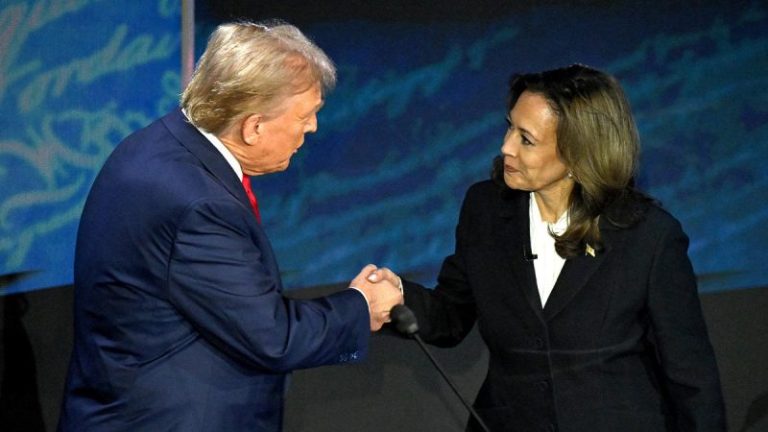
Former Vice President Kamala Harris revealed her debate preparation against Donald Trump during the 2024 election cycle included how to handle a handful of crude hypothetical attacks on abortion and Viagra use, according to her new book, ‘107 Days.’

Bolstered by a team of advisers and a veteran trial attorney Harris compared to a ‘wartime consigliere,’ the then-vice president traveled to the basement of Howard University, her undergraduate alma mater, to prepare for her debate against Trump. Harris had prepped to debate JD Vance in a vice presidential debate ahead of then-President Joe Biden dropping out of the race in July 2024. 

Amid typical debate prep focused on providing Harris with intimate knowledge of topics so she could effectively present her argument on stage, she also was trained for the ‘the painful matter of imagining what kinds of personal attacks Trump might mount against me.’

”He might ask you if you’ve ever had an abortion,’ one adviser said,’ Harris wrote of her time devising her debate strategies. 

‘If he did, the response would be: That’s none of your business and that’s not what we’re here for,’ she continued. 

Harris continued that another individual in the debate prep room floated ‘a dark joke that if he got that personal, I should ask if he took Viagra.’

‘Another: Had he ever paid for an abortion?’ she continued. 

The pair were asked about abortion during the debate, but it never culminated into personal attacks on hypothetical abortions or Viagra use. 

‘In the end, he didn’t go down that track. He probably knew a question like that would be exceedingly thin ice for him—and would infuriate just about every woman in America,’ Harris wrote. 

Harris added that her team wrote a debate card ‘for every nuance of every subject, and once I memorized what was on that card, I’d draw a big, loopy X across it.’

‘I am not a trained seal; I’m not going to memorize lines and spout them. I have to understand the logic and building blocks of every argument so I can present it clearly and defend it persuasively,’ she wrote.

Harris’ book, ‘107 Days,’ hit shelves Tuesday and reflects on the 107 days she had on the presidential campaign trail after Biden dropped out of the race amid mounting concern over his mental acuity. 

Harris failed to rally enough support to defeat Trump, losing each of the seven battleground states Nov. 4, 2024. 

This post appeared first on FOX NEWS

President Donald Trump is set to attend Tuesday’s unprecedented all-hands meeting of U.S. military commanders in Quantico, Va., he said Sunday.

As speculation swirls over why generals and flag officers from around the world were summoned, Trump insisted the purpose was celebratory.

‘It’s really just a very nice meeting talking about how well we’re doing militarily, talking about being in great shape, talking about a lot of good, positive things. It’s just a good message,’ Trump told NBC News.

‘We have some great people coming in, and it’s just an ‘esprit de corps.’ You know the expression ‘esprit de corps’? That’s all it’s about. We’re talking about what we’re doing, what they’re doing, and how we’re doing.’

The gathering represents a major logistical and security feat, concentrating nearly every top U.S. military leader in one location. Trump’s attendance raises the stakes further, putting the Secret Service in charge of security.

Hundreds of generals, admirals and their senior enlisted leaders — ranked one star and above — were ordered last week to attend the meeting with War Secretary Pete Hegseth. The invitation offered no stated reason, fueling speculation it could herald mass cuts consistent with Hegseth’s push to shrink the general officer corps.

Sen. Tammy Duckworth, D-Ill., wrote to the Pentagon seeking details on the cost of flying in officers on such short notice and whether virtual alternatives were considered. About 800 general and flag officers are stationed worldwide, and together with their enlisted advisors and aides, the number descending on Quantico could exceed 1,000, according to Duckworth. She also asked what accounts would cover the costs, whether return travel might be disrupted by a potential government shutdown, and if a cost-benefit analysis preceded the decision to meet in person.

Defense officials and analysts have suggested the meeting may preview cuts not only to the general officer ranks but also to civilian and contractor roles at bases worldwide. Others believe it could foreshadow reductions to the U.S. force posture in Europe and the Middle East, consistent with an expected national defense strategy that prioritizes homeland defense after years of emphasis on the Indo-Pacific and China.

Hegseth has pledged to cut the general officer corps by 20 percent and has already dismissed roughly two dozen senior officers. Reports also suggest he intends to use the meeting to stress his ‘warrior ethos,’ which defense sources suggest could be a way to remind commanders of their duty to remain apolitical, and reassert his personal authority over the force.

Last week, Trump signed an executive order directing law enforcement and the military to counter ‘domestic terrorism and organized political violence.’ On Sunday, at Trump’s direction, Hegseth informed the adjutant general of the Oregon National Guard that 200 troops would be deployed for 60 days to protect immigration enforcement officials facing protests. The federalized Guard members will serve under U.S. Northern Command.

This post appeared first on FOX NEWS

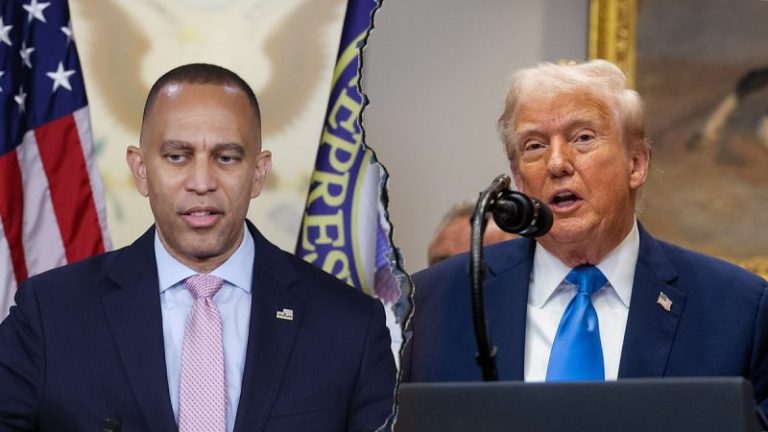
House Minority Leader Hakeem Jeffries, D-N.Y., has signaled that Democrats are not budging on their key demands ahead of a high-stakes meeting with President Donald Trump about government funding.

The federal government will enter a partial shutdown at midnight on Wednesday if Republicans and Democrats do not reach a deal on funding priorities for fiscal year (FY) 2026, which ends at the end of the day on Sept. 30.

All but one House Democrat rejected Republicans’ plan for a roughly straightforward extension of FY 2025 funding levels, through Nov. 21, aimed at giving appropriators more time for a longer-term deal.

Jeffries blasted the measure — called a continuing resolution (CR) — as partisan and has demanded that Republicans make concessions on healthcare in exchange for Democratic support.

He signaled during a last-minute news conference on Monday that Democrats would reject anything less than a written plan to extend Affordable Care Act (ACA) subsidies enacted during the COVID-19 pandemic.

‘No one can trust their word on healthcare. Are you kidding me? These people have been trying to repeal and displace people off the Affordable Care Act since 2010. That’s 15 years,’ Jeffries said. ‘And on behalf of the American people, we’re supposed to simply take their word that they’re willing to negotiate? The American people know that would be an unreasonable thing for us to do.’

Jeffries also pointed out that an alternate CR offered by Democrats would expand those subsidies under the ACA, colloquially known as ‘Obamacare,’ permanently.

It comes hours before he, Senate Minority Leader Chuck Schumer, D-N.Y., House Speaker Mike Johnson, R-La., and Senate Majority Leader John Thune, R-S.D., are set to meet with Trump to discuss government funding at 3 p.m. on Monday.

Johnson and Thune, along with other Republicans in Congress, have been pushing Democrats to accept the deal on the table — pointing out that funding levels have remained roughly the same since former President Joe Biden’s time in office.

‘We are ready, we are willing, we are able to find a bipartisan path forward and reach a spending agreement that actually keeps the government open, but meets the needs of the American people in terms of their health, their safety, and their economic well-being related to lowering the high cost of living, as opposed to allowing tens of millions of Americans to experience dramatically increased health care costs,’ Jeffries told reporters.

‘What we will not do is support a partisan Republican spending bill that continues to gut the healthcare of the American people.’

The COVID-era Obamacare subsidies are due to expire at the end of this year without any action by Congress.

Thune told NBC News’ ‘Meet the Press’ on Sunday that he would be open to negotiating a deal but not paired with the current government funding talks.

‘We can have that conversation, but before we do, release the hostage. Set the American people free, keep the government open, and then let’s have a conversation about those premium tax credits. I’m certainly open to that. I think we all are,’ he said. 

‘I will say … that particular program is desperately in need of reform. It’s fraught with waste, fraud and abuse. So we are going to have reforms if we take action there, but I think there’s potentially a path forward.’

The GOP-led CR passed the House earlier this month largely along party lines.

It’s now on the Senate, where at least several Democrats will be needed to reach the 60-vote threshold to proceed with the bill.

Schumer is under tremendous pressure by his left flank after playing a key role in advancing Republicans’ earlier CR in March, which extended through Sept. 30.

This time, however, Jeffries assured that he and Schumer are in ‘lock-step’ on bucking the Republican plan unless a compromise is reached.

He said of their upcoming sit-down with Trump, ‘We’re heading into the meeting to have a good faith negotiation about landing the plane in a way that avoids a government shutdown but does not continue the Republican assault on the healthcare of the American people.’

‘Republicans control the House and the Senate, and there’s a Republican president. If the government shuts down, it’s because Republicans want to shut the government down,’ Jeffries said at another point.

Johnson, meanwhile, hammered Democrats’ position in an appearance on ‘Sunday Morning Futures.’

‘We passed a continuing resolution, a simple, very clean, 24-page continuing resolution to keep the government open for seven more weeks, so the appropriators can finish that process,’ Johnson said.

‘And [Schumer] said, ‘No. Instead, I want to add $1.5 trillion in new spending to a seven-week stopgap bill…we want to reinstate free healthcare to illegal aliens paid for by U.S. taxpayer dollars. We want to claw back the $50 billion that we passed, Republicans passed, in our big, beautiful bill, the Working Families Tax Cuts, to provide for rural hospitals and healthcare, and a laundry list of other partisan priorities. He knows it’s a nonstarter.’

This post appeared first on FOX NEWS

The clock is ticking to fund government, and so far, lawmakers do not have a path forward to avert a partial shutdown.

The Senate returned to Washington, D.C., on Monday, and congressional leaders are slated to meet with President Donald Trump to negotiate a deal on funding the government. But the last week has seen both sides point the finger at who would own closing the government.

Lawmakers have until midnight Wednesday to pass a short-term funding extension, or else the government will close. And if it does, it would be the third shutdown under Trump.

A government shutdown happens when Congress can neither pass all 12 appropriations bills needed to fund the government, nor pass a continuing resolution (CR), which typically keeps funding levels static while lawmakers hustle to finish their work on spending bills.

Since 1980, there have been 10 government shutdowns. Only three have happened since the turn of the century.

All shutdowns are different, and the impending shutdown is no exception. However, it could have more devastating effects on the federal workforce than previous shutdowns given the administration’s orders to undertake mass firings.

Programs like Medicare, Social Security and Medicaid will continue, along with the Postal Service, Veterans’ Affairs hospitals and clinics, and Immigration and Border Patrol security activities, among others. Federal employees will likely go without pay, however, and a string of agencies will see their services hampered by furloughs, like the IRS and Small Business Administration. Housing programs may also see a delay in rental assistance and loans.  

Typically, shutdowns see thousands of federal workers deemed ‘nonessential’ furloughed, but the Office of Management and Budget (OMB) released a memo last week that directed agencies to ‘use this opportunity to consider reduction in force (RIF) notices for all employees’ in programs that have no other available funding source and that don’t comport with Trump’s priorities if lawmakers couldn’t fund the government.

‘RIF notices will be in addition to any furlough notices provided due to the lapse in appropriation,’ the memo read, and they will be issued ‘regardless of whether the employee is excepted or furloughed during the lapse in appropriations.’

Then there is the cost of a shutdown. While the cost of a partial closure this year is unknown, the Congressional Budget Office did an analysis of the cost of the last time the government shuttered in 2019.

The report, published in January 2019, found that the shutdown saw roughly $18 billion in federal spending delayed, which led to a dip in that year’s first quarter gross domestic product of $8 billion. The report noted roughly $3 billion of that would not be recovered.

It also found that federal workers who received delayed payments and private businesses were the hardest hit.

‘Some of those private-sector entities will never recoup that lost income,’ the report stated.

Congressional Republicans and Democrats are at a stalemate on the current CR, not so much because of what’s in the bill — it would keep the government open until Nov. 21 and includes tens of millions in new spending for lawmakers’ security — but because of what it lacks.

Democratic lawmakers demanded that the short-term extension at least include an extension to expiring Obamacare premium subsidies and have warned that if Congress doesn’t act, millions of Americans will see their health care costs increase.

While the subsidies don’t expire until the end of the year, congressional Democrats have noted that insurers are gearing up to send out new rates on Oct. 1.

But Senate Republicans, including Senate Majority Leader John Thune, R-S.D., have said that conversations about the subsidies can happen after the government is funded, but that has so far not been enough for Senate Minority Leader Chuck Schumer, D-N.Y., and Senate 
Democrats.

‘Fundamentally, nothing has changed, though, and the choice remains the same: Democrats can either vote for a clean, short-term, nonpartisan CR that prioritizes the American people, or they can choose a completely avoidable shutdown that prioritizes politics above all else,’ Thune told NBC’s ‘Meet the Press.’

Both Thune and Schumer, along with House Speaker Mike Johnson, R-La., and House Minority Leader Hakeem Jeffries, D-N.Y., will meet with Trump Monday afternoon. The confab comes after Trump canceled a meeting with the Democratic leaders earlier this week.

Schumer and Jeffries said in a joint statement after a new meeting was set that ‘Democrats will meet anywhere, at any time and with anyone to negotiate a bipartisan spending agreement that meets the needs of the American people.’

‘We are resolute in our determination to avoid a government shutdown and address the Republican health care crisis,’ they said. ‘Time is running out.’ 

This post appeared first on FOX NEWS

Top Democrats are striking two very different notes on accountability: cheering President Donald Trump‘s felony conviction as proof that ‘no one is above the law,’ while blasting the recent indictment of former FBI Director James Comey as pure political payback.

In 2019, then-Speaker of the House Nancy Pelosi said during a discussion at the Commonwealth Club in San Francisco that Democrats believe ‘no one is above the law,’ including the commander-in-chief. 

‘Everybody wants the president to be held accountable in the most serious way. And everybody believes, now I’m talking on the Democratic side, that no one is above the law, especially the President of the United States,’ Pelosi said.

Former President Joe Biden reiterated the ‘no one is above the law’ mantra before his White House remarks on the Middle East on May 31, 2024.

He said the New York case against Trump was ‘a state case, not a federal case,’ decided by ‘a jury of 12 citizens’ after five weeks of evidence and deliberation. 

The jury, Biden noted, ‘reached a unanimous verdict’ finding Trump guilty on 34 felony counts, while emphasizing that Trump has the right to appeal.

‘That’s how the American system of justice works,’ Biden said, calling it ‘reckless, dangerous, and irresponsible’ to claim the trial was rigged simply because of an unfavorable outcome.

Senate Minority Leader Chuck Schumer, D-N.Y., addressed Trump’s conviction in a June 3, 2024, floor speech saying that ‘former President Donald Trump is now a convicted felon.’

‘The most important takeaway from this case is that nobody’s above the law, including Donald Trump,’ he added.

On the heels of Comey’s indictment, Schumer said Sunday that he has ‘no faith in Trump’s judicial system.’

Schumer said on NBC News’ ‘Meet the Press’ that Trump ‘has turned this judicial system to be his own political fighter.’

‘He tells them to go after people he doesn’t like. He tells them to exonerate people that he likes,’ Schumer said.

Sen. Tim Kaine, D-Va., denounced what he called a ‘malicious prosecution,’ reminding reporters that Trump previously fired a prosecutor who refused to bring ‘frivolous charges.’

Sen. Mark Warner, D-Va., vice chair of the Senate Intelligence Committee, issued an even sharper rebuke. 

‘This kind of interference is a dangerous abuse of power,’ he warned. ‘By ousting a respected, independent prosecutor and replacing him with a partisan loyalist, Trump is undermining one of the most important U.S. attorney’s offices in the country and eroding the rule of law itself.’

As Democrats leaned on the ‘no one is above the law’ refrain, Trump struck back — telling reporters Friday at the White House that the indictment against the former FBI chief was about rooting out corruption, not political payback.

‘It’s about justice really, it’s not revenge,’ Trump said. ‘It’s also about the fact that you can’t let this go on. They are sick, radical left people, and they can’t get away with it, and Comey was one of the people.’

‘He wasn’t the biggest, but he’s a dirty cop,’ Trump said, adding, ‘He’s always been a dirty cop. Everybody knew it.’

Trump’s comments came after Comey was indicted by a grand jury for allegedly lying to Congress and obstructing a congressional proceeding. He was indicted on two counts: alleged false statements within the jurisdiction of the legislative branch and obstruction of a congressional proceeding.

Comey’s arraignment is set for 10 a.m. on Oct. 9 before District Judge Michael S. Nachmanoff. If convicted, Comey faces up to five years in prison.

Fox News Digital’s Michael Dorgan and Emma Bussey contributed to this report.

This post appeared first on FOX NEWS