
Archive

June 4, 2026

Browsing

Growing up in South Florida, Jozy Altidore heard a lot of Spanish playing soccer with local kids and at home from his Dominican grandmother. As a teenager, he went to play for Villarreal, in the Castellón part of Spain, an area that isn’t that touristy. His coach and teammates mostly spoke Spanish. Along the way, Altidore picked up the language.

“A lot of people look at me like, ‘What? You speak Spanish?’” Altidore told NBC News.

It will come in handy this summer, when Altidore serves as a World Cup commentator for Telemundo, the games’ official Spanish-language network. Altidore has no experience in broadcasting, and he admits that his Spanish is just OK. But he saw the World Cup was coming to North America, and he didn’t want to be left on the sidelines.

“It’s the biggest, most historical World Cup we’ve had,” Altidore said. “For me, it was a good opportunity to stay involved, be a part of the World Cup.”

But what about his Spanish? “I can get by,” he said. “I thought, ‘What a cool challenge.’ I think you want to challenge yourself, in the things that you’re doing, always.”

Plus, he’ll get to see the Telemundo broadcast up close, the excitement of it, which is a stark contrast to the English-language telecasts, particularly the “goal” calls from the announcer Andrés Cantor. “I always wondered, how does he do that in one breath?” Altidore said. “This guy goes just the whole time. I can’t wait to see the legend in action.” (Telemundo and NBC News share a parent company, NBCUniversal.)

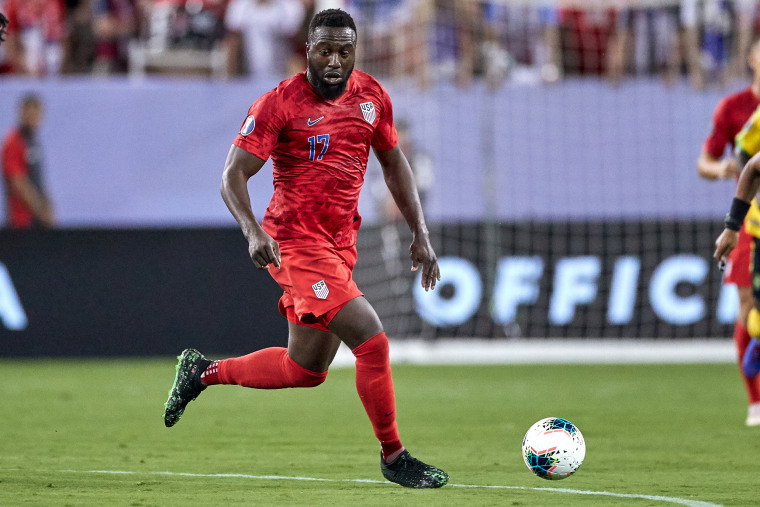
Altidore during the Gold Cup semifinal match between the U.S. and Jamaica in Nashville, Tenn., on July 3, 2019.Robin Alam / Icon Sportswire via Getty Images file

Altidore will be offering analysis and insight on Team USA’s games not far removed from his own time playing for the team. He is considered one of the best American players of the last two decades, a striker who scored 42 goals in 115 appearances. He helped the U.S. make it to the 2010 and 2014 World Cups, though he got injured during the latter tournament. He played with a few members of the 2026 roster, including Christian Pulisic.

Altidore told NBC News he has a rose-colored view of the current team. “I’m optimistic,” he said. “I’m bullish. I think this team can win the World Cup. I really do. I think they have the talent. And I’m so excited for them to get their flowers.”

Altidore understands how that sounds: Team USA? Winning the World Cup? But he pointed to past examples of host countries making deep runs in the tournament: South Korea reaching the semifinals in 2002, and Germany doing the same in 2006. Colombia also reached the quarterfinals in 2014, when the World Cup was held in neighboring Brazil.

With this World Cup being held on home soil, maybe “we’re able to push our team to a bit of a better performance than we have historically,” Altidore said.

He didn’t just mean the players — he meant the fans, too. “Can we show up in numbers in a way that, from the players’ arrival, they feel the emotion, they feel the enthusiasm, they feel the camaraderie?” Altidore said. “And we can push them on to play a little bit above themselves, to play a little bit above what we’ve seen already.”

You can sense his excitement. As a media member, Altidore will have to now learn to balance his rooting interests with offering clear-eyed analysis. “For me, it’s really getting behind these guys, applauding them for how far they’ve now taken the flag and where they’ve brought it,” he said. “But at the same time, it’s not all rainbows. You’ve got to be critical of guys, and you have to obviously critique their performances.”

Altidore was first introduced to soccer in 1994, the last time the U.S. hosted the World Cup, when he was just a young boy. His father recorded games on VHS tapes. He imagines lots of families will do the same this summer, three decades later, albeit with updated technology.

“They’re going to get exposed to soccer in a wonderful way for the first time, and it’s going to birth soccer players, it’s going to birth soccer fans, soccer enthusiasts,” Altidore said.

He’ll be doing his part, by showing his enthusiasm on the Telemundo broadcasts. “It’s more than just X’s and O’s in my opinion,” Altidore said. “This is a very good opportunity to continue growing the game for another 30, 40 years to come.”
The Trump administration has proposed new tariffs of up to 12.5% on imports from 60 economies after determining they had failed to curb trade in goods ‌made with forced labor, an assertion that was rejected by its trading partners.

The proposal from the U.S. Trade Representative’s office, issued late on Tuesday, comes from a Section 301 unfair trade practices investigation designed to help rebuild U.S. President Donald Trump’s emergency tariffs, struck down by a U.S. Supreme Court decision in February.

Despite laws banning them, the products of forced labor are deeply embedded in supply chains around the world. But European lawmakers in particular bristle at the ​accusation that the region is less effective than the U.S. at curbing the trade in such goods, with one describing the U.S. findings as “utterly absurd.”

The USTR proposed 10% additional ​duties on imports from Canada, Ecuador, the European Union, Indonesia, Mexico, Pakistan, Argentina, Bangladesh, Cambodia, El Salvador, Guatemala, Malaysia, Taiwan and Britain. The USTR said ⁠all had plans or partial schemes in place.

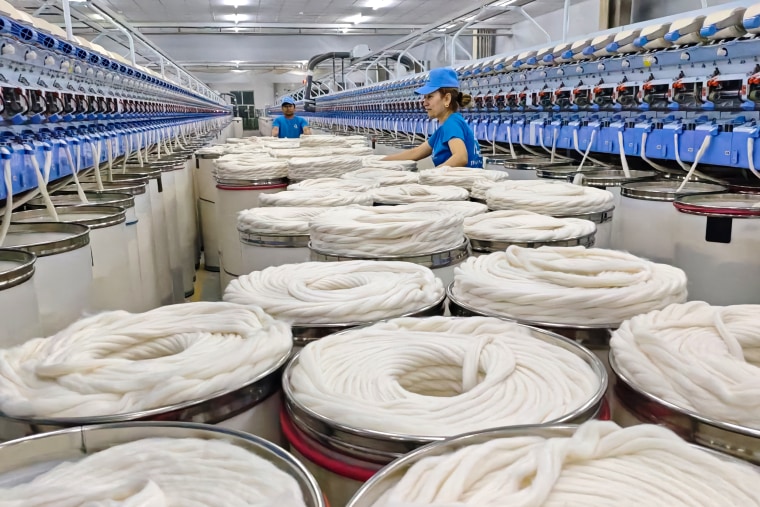
Employees work on the spinning production line at a workshop of a textile factory in Xinjiang Uygur Autonomous Region of China on March 5.Bao Liangting / VCG via Getty Images file

The trade agency said it would impose additional duties of 12.5% on the remaining 45 countries that it investigated. These include China, India, Nigeria, Japan, ​South Korea, Vietnam, Australia and New Zealand.

“The failure of our most important trading partners to address the importation of goods made with forced labor is unacceptable,” U.S. Trade Representative Jamieson Greer said in a ​statement. “This creates a dynamic where American workers are forced to compete globally on an unlevel playing field.”

The USTR said it would accept public comments on the proposed tariffs and other remedies through July 6, with a public hearing scheduled for July 7.

The announcement comes ahead of the July 24 expiration of a 10% temporary tariff imposed by the Trump administration on Feb. 20, the day the Supreme Court struck down Trump’s ​tariffs under the International Emergency Economic Powers Act.

The European Commission said the tariffs were unjustified and reiterated its commitment to the trade deal sealed with Washington last year.

Bernd Lange, the chair of the European ​Parliament’s trade committee, which voted on Tuesday to accept that trade deal, said the new tariffs were expected, but said the results of the U.S. investigation were still “utterly absurd” given a 2024 E.U. law to ban imports ‌of forced labor ⁠products.

“The impression is increasingly emerging that a tariff measure is sought first, and only then is a suitable legal justification found,” he said. However, he added that the key question would be whether the additional tariffs would exceed those agreed between both sides last July.

The U.S.’s largest trading partner, the European Union, agreed last July to accept tariffs of 15% on a broad range of its exports. In its report, the USTR said the E.U. measures came into force only in December 2027 and lacked key elements.

“We know there are ups and downs in what people say,” French Finance Minister Roland Lescure ​told reporters after a Cabinet meeting. “But the goal ​is to ratify the (trade) accord and stick ⁠to that.”

Britain said it was in regular talks with the United States and was taking action to tackle forced labor. It added that the preferential access to U.S. markets that it had negotiated for U.K. businesses remained in place.

Taiwan said it was “hopeful and confident” that the final results would reflect agreements ​already reached, securing relatively preferential treatment.

Beijing, facing 12.5% tariffs, said that it opposed all forms of unilateral tariffs and that there was no forced labor ​in China. India, confronted with ⁠the same rate, said it was engaged with Washington on the Section 301 proceedings, noting the proposed tariffs were not final.

On Monday, the USTR proposed a 25% duty on many Brazilian goods as a result of a Section 301 investigation into the country’s digital trade practices and preferential tariffs.

The trade agency is also expected to soon unveil the findings of another major Section 301 probe into the buildup of excess industrial capacity ⁠in 16 trading ​partners, including China and the European Union.

In the forced labor findings, the USTR said it would exempt from tariffs ​products including energy, rare earths and some other metals, beef, coffee, certain fruits and vegetables, pharmaceuticals, organic chemicals and aircraft parts.

It also said it was proposing a textile mechanism that would allow for a certain volume of apparel and textile imports ​to enter the U.S. at a reduced tariff rate, without giving details.